INTRODUCTION
The story of the coin in the fish’s mouth, found in Matthew 17:24–27, offers us a glimpse into the grace and freedom that Jesus offers each one of us. When confronted with the question of paying the temple tax, Jesus reminds Peter that the children of the King are free. Through this unusual encounter, we discover a truth that reaches far beyond a simple tax payment: that our broken relationship with God is not healed through religious duties or human efforts, but by the unmerited favor of God revealed in Jesus Christ.
As we explore this passage and read Robert Capon’s meditation on this story, we are invited to reconsider what it means to live in the Kingdom of God. Too often, we approach faith as though we must earn God’s favor through our good deeds, religious practices, or spiritual achievements. Yet the gospel announces a radically different message. Through the death and resurrection of Jesus, God has accomplished what none of us could ever achieve for ourselves. Through trusting in Christ, we are welcomed as sons and daughters of God, set free from the burden of trying to earn what He is freely willing to give.
Yet this freedom is not an invitation to passivity or indifference. Although salvation is a gift we can‘t earn, it is a gift that calls for a response. Having received God's grace, we are invited to respond with faith, gratitude, love, and a willingness to follow Jesus. Our good works and obedience do not earn God's love or secure our salvation; rather, they become the fruit of a life transformed by the grace we have received. We do not live faithfully in order to become God's children; we live faithfully because, through Christ, we already are.
May this reflection open your heart to the liberating truth of God’s grace and deepen your confidence in the finished work of Jesus Christ. May you trust Him and rest in the freedom of being a beloved child of God, knowing that His love is not something you must earn, but a gift you are invited to receive. May the peace of Christ fill your heart, the grace of God sustain you, and the freedom of being a child in His kingdom bring you joy today and always. Amen.
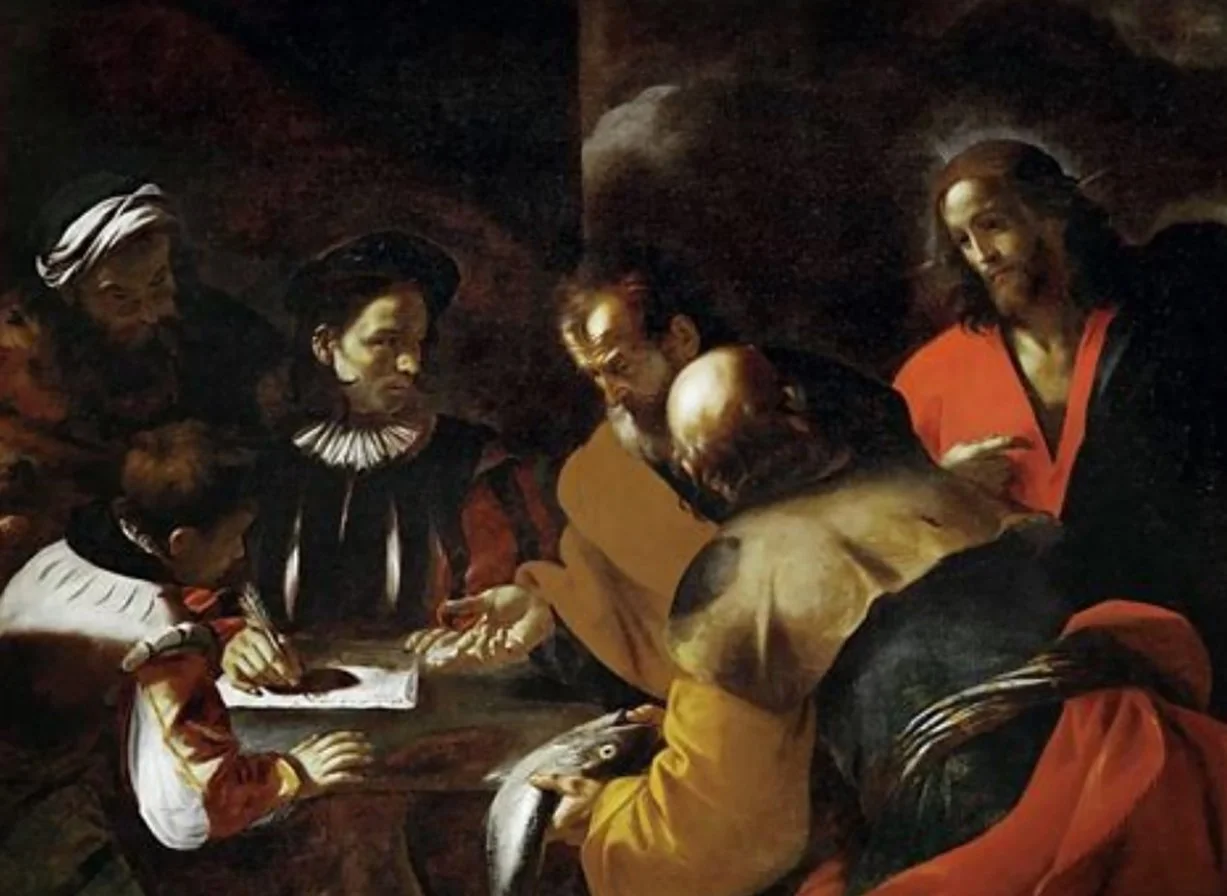
Peter Paying the Temple Tax With the Coin from the Fish’s Mouth - Painting by Mattia Preti in 1640
Background on the Temple Tax
This little story — unique to Matthew’s gospel — concerns the temple tax which was a tax first imposed by Moses in the Book of Exodus for the upkeep of the tabernacle in the wilderness. It is a story that is full of interest.
Matthew 17:24-27 . . . When they came to Capernaum, the collectors of the half-shekel tax went up to Peter and said, “Does not your teacher pay the tax?” He said, “Yes.” And when he came home, Jesus spoke to him first, saying, “What do you think, Simon? From whom do kings of the earth take toll or tribute? From their sons or from others?” And when he said, “From others,” Jesus said to him, “Then the sons are free. However, not to give offense to them, go to the sea and cast a hook, and take the first fish that comes up, and when you open its mouth you will find a shekel; take that and give it to them for me and for yourself.”
Exodus 30:11-16 . . . Then the Lord said to Moses, “Whenever you take a census of the people of Israel, each man who is counted must pay a ransom for himself to the Lord. Then no plague will strike the people as you count them. Each person who is counted must give a small piece of silver as a sacred offering to the Lord (this payment is half a shekel, based on the sanctuary shekel). All who have reached their twentieth birthday must give this sacred offering to the Lord. 15 When this offering is given to the Lord to purify your lives, making you right with him, the rich must not give more than the specified amount, and the poor must not give less. 16 Receive this ransom money from the Israelites, and use it for the care of the Tabernacle. It will bring the Israelites to the Lord’s attention, and it will purify your lives.”
Under Moses, the tax was imposed every time there was a census, but by the time of Jesus it was an annual tax which, though it lacked the sanction of Roman law, every Jew between the ages of twenty and fifty was expected to pay. And that brings us to the first point of interest. For although Jesus and his disciples were all there, newly arrived together in Capernaum when the demand for the temple tax was made, only Jesus and Peter ended up paying the tax.
Why just those two? Surely it must have been that they were the only two people in the company who were over the age of twenty. In other words, Jesus’ other eleven disciples must still have been in their teens — though we usually imagine them to be older, closer to the age of Jesus. But the fact is that, in those days, someone who wanted to be a rabbi’s talmid or disciple would generally join him at the age of fifteen; so there would be nothing at all unusual about James, John, Andrew, Philip and the rest all being little more than boys.
So much for the background. What of the teaching? Peter is clearly being taken to task for affirming that Jesus does pay the temple tax, but why wouldn’t he pay it? He was a Jew over the age of twenty. On what grounds could he possibly be exempt? Jesus explains by way of a rabbinical kind of question. Do kings who impose taxes collect them from their own sons? No. So work it out for yourself Peter … Who is the king who collects the temple tax? God. The temple tax is an obligation to God. But what has Peter just heard God say about Jesus on the mount of transfiguration? “This is my Son, whom I love; with him I am well pleased. Listen to him!” (Matthew 17.5). So should Jesus, as God’s son, pay the tax due to God? No, “the sons are exempt”.
I note the plural. The sons are exempt; not the son is exempt. Jesus is including Peter in his sonship exemption, and when he instructs Peter to pay the tax it is “so that we may not offend them.” The new kingdom, the kingdom of God that has dawned with the coming of Jesus, is a kingdom of no-one but those who are sons and daughters of God. Or to put it the other way round: all who enter the kingdom of God through Jesus (and there is no other way) become sons and daughters of God by doing so.
John 1:12 . . . “Yet to all who did receive him, to those who believed in his name, he gave the right to become children of God”.
The First Parable of Grace
The Coin in the Fish’s Mouth
By Robert Capon
Excerpt from His Book, “Kingdom, Grace, Judgment”
The general thrust of my treatment of the coin in the fish's mouth - and especially of Jesus' words, "then the children are free" - is to interpret the whole passage as a proclamation of the end of religion. To me, the episode says that whatever it was that religion was trying to do (the religion of the temple in particular and, by extension, all religions everywhere) will not be accomplished by religious acts at all but in the mystery of Jesus' death and resurrection. As I said, that perception seems to have been so liberating to Jesus that he allowed himself the frivolity of this very odd miracle indeed. But beyond that, it is also (or at least it should be) radically liberating to everyone.
The entire human race is profoundly and desperately religious. From the dim beginnings of our history right up to the present day, there is not a man, woman, or child of us who has ever been immune to the temptation to think that the relationship between God and humanity can be repaired from our side, by our efforts. Whether those efforts involve creedal correctness, cultic performances, or ethical achievements - or whether they amount to little more than crassly superstitious behavior - we are all, at some deep level, committed to them. If we are not convinced that God can be conned into being favorable to us by dint of our doctrinal orthodoxy, or chicken sacrifices, or the gritting of our moral teeth, we still have a hard time shaking the belief that stepping over sidewalk cracks, or hanging up the bath towel so the label won't show, will somehow render the Ruler of the Universe kindhearted, softheaded, or both.
But as the Epistle to the Hebrews pointed out long ago, all such behavior is bunk. The blood of bulls and goats cannot take away sins, nor can any other religious act do what it sets out to do. Either it is ineffective for its purpose, or the supposedly effective intellectual, spiritual, or moral uprightness it counts on to do the job is simply unavailable. The point is, we haven't got a card in our hand that can take even a single trick against God. Religion, therefore - despite the correctness of its insistence that something needs to be done about our relationship with God - remains unqualified bad news: it traps us in a game we will always and everywhere lose.
But the Gospel of our Lord and Savior Jesus Christ is precisely Good News. It is the announcement, in the death and resurrection of Jesus, that God has simply called off the game - that he has taken all the disasters religion was trying to remedy and, without any recourse to religion at all, set them to rights by himself. How sad, then, when the church acts as if it is in the religion business rather than in the Gospel-proclaiming business. What a disservice, not only to itself but to a world perpetually sinking in the quagmire of religiosity, when it harps on creed, cult, and conduct as the touchstones of salvation. What a perversion of the truth that sets us free (John 8:32) when it takes the news that while we were yet sinners, Christ died for us (Rom. 5:8), and turns it into a proclamation of God as just one more insufferable bookkeeper.
I realize this is a long fetch from the parable of the coin in the fish's mouth, but I make no apologies. In fact, I end with something even farther fetched. The Messiah whom Jesus' contemporaries expected - and likewise any and all of the messiahs the world has looked to ever since - are like nothing so much as religious versions of "Santa Claus is coming to town." The words of that Christmas song sum up perfectly the only kind of messianic behavior the human race, in its self-destructive folly, is prepared to accept: "He's making a list; he's checking it twice; he's going to find out who's naughty, or nice" - and so on into the dark night of all the tests this naughty world can never pass.
For my money, what Jesus senses clearly and for the first time in the coin in the fish's mouth is that he is not, thank God, Santa Claus. He will come to the world's sins with no lists to check, no tests to grade, no debts to collect, no scores to settle. He will wipe away the handwriting that was against us and nail it to his cross (Col. 2:14). He will save, not some minuscule coterie of good little boys and girls with religious money in their piggy banks, but all the stone-broke, deadbeat, overextended children of this world whom he, as the Son of man - the holy Child of God - will set free in the liberation of his death.
And when he senses that ... well, it is simply to laugh. He tacks a "Gone Fishing" sign over the sweatshop of religion, and for all the debts of all sinners who ever lived he provides exact change for free…
Trust Him, therefore, and may your response to His amazing gift of being received as a child of God be one of faith, gratitude, love, and in a willingness to follow and serve Him.