God Is and He May Be Known
Introduction
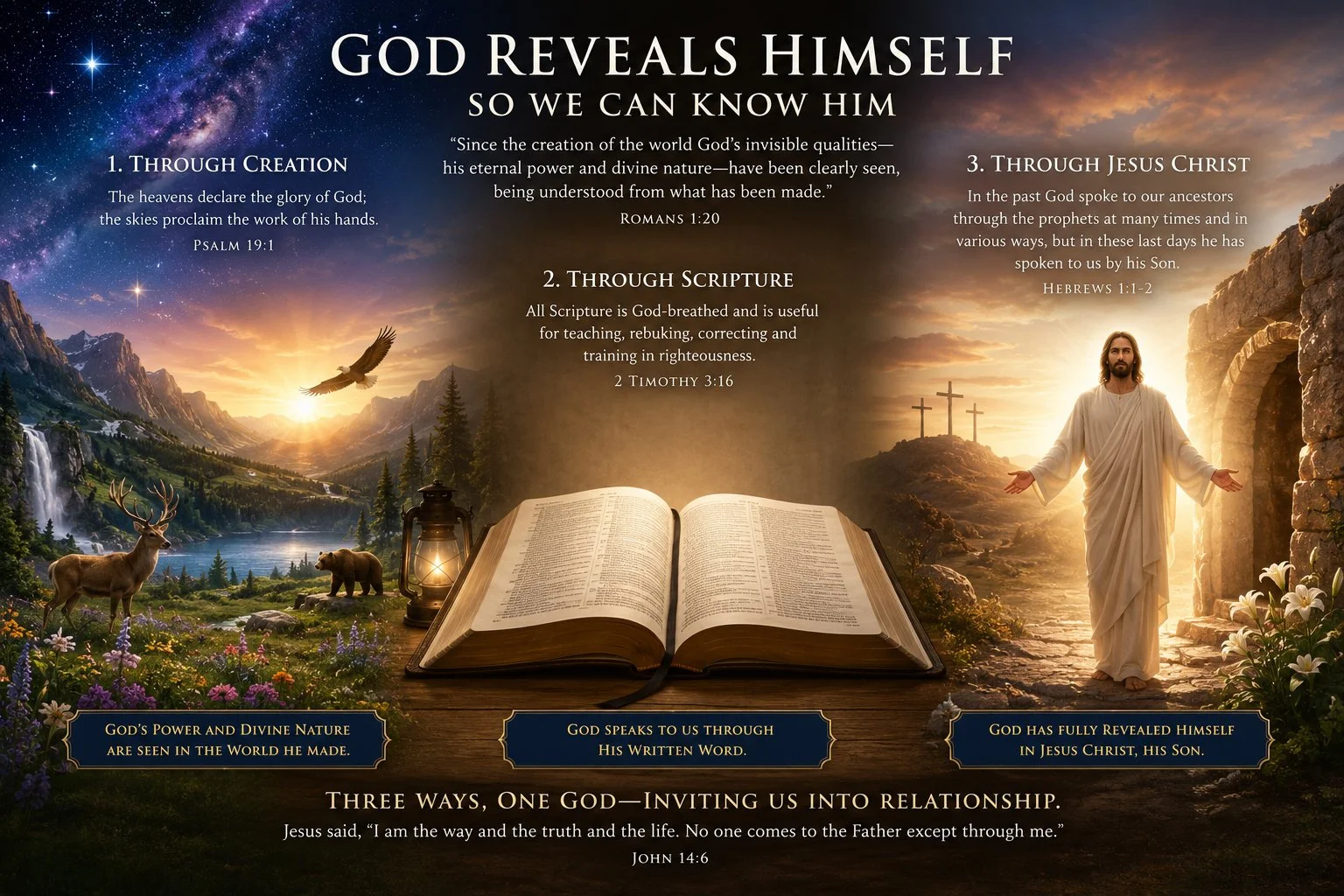
Does God exist and, if so, can He truly be known? These timeless questions have shaped human history, prompted countless people to seek answers, and stand at the very heart of the Christian faith. Christianity does not merely state that God exists—it proclaims that the Creator of the universe has chosen to reveal Himself. Rather than leaving humanity to search blindly, Christians believe God makes Himself known through creation, our consciences (the human mind and heart), through Scripture, and, most fully, through Jesus Christ.
Understanding God’s nature is more than an intellectual exercise; it’s an invitation to know personally the One who is eternal, sovereign, holy, loving, and faithful. The Bible presents God as self-existent, all-powerful, all-knowing, and yet intimately present with His creation. He is both infinitely exalted above the universe and wonderfully near to those who turn to Him.
In this post, we will consider relevant Scripture along with two articles from GotQuestions.org that address these fundamental questions: (1) “Does God Exist?” and (2) “How Does God Reveal Himself to Us?” As you ponder these questions may the Lord open your heart and mind to the reality that “God is” and that He has graciously made Himself known. And, if the answers are convincing, may you respond in faith to His invitation to seek Him, know Him, and walk with Him today and throughout eternity. Amen.
Relevant Scripture
Genesis 1:1 . . . “In the beginning God created the heavens and the earth.”
Isaiah 40:26 . . . “Lift up your eyes and look to the heavens: Who created all these? He who brings out the starry host one by one and calls forth each of them by name. Because of his great power and mighty strength, not one of them is missing.”
Job 12:7-10 . . . “But ask the animals, and they will teach you, or the birds in the sky, and they will tell you; or speak to the earth, and it will teach you, or let the fish in the sea inform you. Which of all these does not know that the hand of the Lord has done this? In his hand is the life of every creature and the breath of all mankind.
Ecclesiastes 3:10-13 . . . What do workers gain from their toil? I have seen the burden God has laid on the human race. He has made everything beautiful in its time. He has also set eternity in the human heart; yet no one can fathom what God has done from beginning to end. I know that there is nothing better for people than to be happy and to do good while they live.
Jeremiah 29:13 . . . “You will seek me and find me when you seek me with all your heart.”
Jeremiah 9:23-24 . . . “Let not the wise man boast of his wisdom or the strong man boast of his strength or the rich man boast of his riches but let him who boasts boast about this: that he understands and knows me, that I am the LORD, who exercises kindness, justice and righteousness on earth, for in these I delight,” declares the LORD.
Romans 1:20 . . . “For since the creation of the world God’s invisible qualities—his eternal power and divine nature—have been clearly seen, being understood from what has been made, so that men are without excuse.”
Hebrews 1:1-3 . . . “In the past God spoke to our forefathers through the prophets at many times and in various ways, but in these last days he has spoken to us by his Son, whom he appointed heir of all things, and through whom he made the universe. The Son is the radiance of God’s glory and the exact representation of his being, sustaining all things by his powerful word. After he had provided purification for sins, he sat down at the right hand of the Majesty in heaven.”
Hebrews 4:12 . . . “For the word of God is alive and active. Sharper than any double-edged sword, it penetrates even to dividing soul and spirit, joints, and marrow; it judges the thoughts and attitudes of the heart.”
2 Timothy 3:16-17 . . . “All Scripture is God-breathed and is useful for teaching, rebuking, correcting and training in righteousness, so that the servant of God may be thoroughly equipped for every good work.”
Matthew 7:7-8 . . . “Ask and it will be given to you; seek and you will find; knock and the door will be opened to you. For everyone who asks receives; he who seeks finds; and to him who knocks, the door will be opened.”
Colossians 1:15 . . . “The Son is the image of the invisible God, the firstborn over all creation.”
John 1:18 . . . “No one has ever seen God, but the one and only Son, who is Himself God and is at the Father’s side, has made Him known.”
John 11:25-27 . . . Jesus said to her, “I am the resurrection and the life. The one who believes in me will live, even though they die; and whoever lives by believing in me will never die. Do you believe this?” “Yes, Lord,” she replied, “I believe that you are the Messiah, the Son of God, who is to come into the world.”
John 14:8-10 . . . Philip said to Him, “Lord, show us the Father, and that will be enough for us.” Jesus replied, “Philip, I have been with you all this time, and still you do not know Me? Anyone who has seen Me has seen the Father. How can you say, ‘Show us the Father’? Do you not believe that I am in the Father and the Father is in Me?”
John 14:23-27 . . . Jesus replied, “Anyone who loves me will obey my teaching. My Father will love them, and we will come to them and make our home with them. Anyone who does not love me will not obey my teaching. These words you hear are not my own; they belong to the Father who sent me. “All this I have spoken while still with you. But the Advocate, the Holy Spirit, whom the Father will send in my name, will teach you all things and will remind you of everything I have said to you. Peace I leave with you; my peace I give you. I do not give to you as the world gives. Do not let your hearts be troubled and do not be afraid.”
John 17:3 . . . “Now this is eternal life: that they know you, the only true God, and Jesus Christ, whom you have sent.”
Philippians 2:8-11 . . . And being found in appearance as a man, he humbled himself by becoming obedient to death—even death on a cross! Therefore God exalted him to the highest place and gave him the name that is above every name, that at the name of Jesus every knee should bow, in heaven and on earth and under the earth, and every tongue acknowledge that Jesus Christ is Lord, to the glory of God the Father.
Revelation 1:8 . . . “I am the Alpha and the Omega,” says the Lord God, “who is, and who was, and who is to come, the Almighty.”
2 Corinthians 4:18 . . . “So we fix our eyes not on what is seen, but on what is unseen. For what is seen is temporary, but what is unseen is eternal.”
Does God Exist?
From GotQuestions.org
Whether God exists is one of the most basic and important questions any person can consider. Opinions about God abound, but answering the question “Does God exist?” demands more than a few seconds of attention and involves a wide range of ideas and evidence. Ultimately, what we see in human experience, science, logic, and history leads to a confident answer: yes, God exists.
Often, this question is posed as “Can you prove God exists?” The problem is that, while truth itself is absolute, there are virtually zero instances of absolute proof outside of pure logic and mathematics. For that reason, courtrooms don’t require absolute proof to reach a verdict; rather, they seek to dispel “reasonable doubt” and consider what’s “most probable.”
Demanding “proof” of God that no one could ever reject is unreasonable. Neither evidence nor people function that way in the real world. “Encountering” facts and “accepting” them are profoundly different. Airtight, sound arguments will remain unconvincing to those determined to disbelieve. For the resolute skeptic, it’s not “proof,” even if it would convince almost anyone else. A person’s intent is more influential than any evidence encountered.
That means a certain amount of “faith” is necessary—and not just regarding God’s existence. Perfect knowledge is beyond our ability. Bias and prejudice cloud our views. There will always be a gap between what we can “know” and what we “believe.” This applies equally to skeptics and believers. We cannot possibly know every detail involved every time we sit in a chair, eat food, or climb stairs. Such actions all express a measure of faith. We act, despite what we don’t know, because of what we do know. That’s the essence of biblical faith, including faith in the existence of God. We trust in what is known, leading us to action, despite a less-than-absolute understanding (Hebrews 11:6).
Whether or not one acknowledges God, the decision involves faith. Belief in God does not require blind faith (John 20:29), but neither can it overcome malicious resistance (John 5:39–40). Bolstering faith are human experience, logic, and empirical evidence, all of which help answer the question does God exist?
Does God Exist? — Human Experience
Discussing the existence of God usually starts with logical arguments. That makes sense, but it’s not how human beings normally operate. No one starts devoid of all perspective, waiting to follow a robotically rational path before forming an opinion. People interpret life based on the world around them. So, looking at the existence of God ought to start with experiences. Afterwards, we can use logic to assess those views.
Evidence of God exists in daily human experiences (Romans 1:19–20; Psalm 19:1; Ecclesiastes 3:11). This includes our innate sense of morality. It applies to the apparent design of the universe around us. Human life compels belief that truth, deception, love, hate, goodness, evil, etc., are real and meaningful. The overwhelming majority of people throughout history have been inclined to believe in a reality greater than the physical.
Our experiences are not conclusive evidence, of course. Instead, God uses general revelation as an invitation (Revelation 3:20). Common experiences are meant to emphasize that we ought to seek further answers (Matthew 7:7–8). Those who ignore or disdain God’s invitation don’t have the excuse of ignorance (Romans 1:18; Psalm 14:1).
Does God Exist? — Human Logic
Three of the more powerful logical suggestions of God’s existence are the cosmological, teleological, and moral arguments.
The cosmological argument considers the principle of cause and effect. Each effect is the result of some cause, and each cause is the effect of a prior cause. However, that chain of causes cannot go on infinitely into the past, or else the chain would never actually start. Logic demands something eternally existent and that is not itself the effect of anything else. Our universe, clearly, is not eternal or uncaused. Logic points to God: the uncreated, eternal measure of all other things, the First Cause of our reality.
“ Welcome. And congratulations. Getting here wasn’t easy. I know. To begin with for you to be here now trillions of drifting atoms had to somehow assemble in an intricate and intriguingly obliging manner to create you. It’s an arrangement so specialized and particular that it has never been tried before and will only exist this once. For the next many years (we hope) these tiny particles will uncomplainingly engage in all the billions of deft, cooperative efforts necessary to keep you intact and let you experience the supremely agreeable but generally underappreciated state known as existence...”
The teleological argument examines the structure of the universe. The largest galactic configurations, our solar system, our DNA, subatomic particles—everything gives the appearance of having been purposefully arranged. This trait is so strong that even hardened atheists have difficulty explaining away the appearance of design.
Nothing about subatomic particles or forces indicates they must be arranged as they are. Yet, if they were not exactly as they are, complex matter—and life—would be impossible. Dozens of universal constants coordinate with mind-boggling precision just to make life possible, let alone actual. Science has never observed or explained life arising from non-life, yet it also shows a sudden onset of complex organisms. A team of archaeologists who saw the words “I am here” on a cave wall would universally assume intelligent action. Meanwhile, human DNA represents a coding structure beyond the ability of the best human engineers. The weight of this evidence, logically, favors the idea of an Intelligent Designer—God—as an explanation.
The moral argument points to concepts like good and evil, ethics, and so forth. It’s notable that these are discussions of “what should be,” not merely “what is.” Moral principles are drastically disconnected from the ruthless, selfish reasoning that one would expect of a creature randomly evolved to survive at any cost. The very idea that human beings think in non-physical, moral terms is striking. Beyond that, the fundamental content of human morals remains constant throughout history and across cultures.
Further, discussion of moral ideas leads inevitably to a crossroads. Either moral ideas are completely subjective, and therefore meaningless, or they must be grounded in some unchanging standard. Human experience doesn’t support the conclusion that morals mean nothing. The most reasonable explanation for why people think in moral terms and share moral ideals is a real moral law provided by a Moral Lawgiver, i.e., God.
Does God Exist? — Human Science
The logical arguments above are inspired by observations. Concepts such as the Big Bang Theory demonstrate, at the very least, the scientific validity of a created, non-eternal universe. Likewise for the structure of DNA. Empirical data lends credibility to the idea of a biblical Creator and contradicts alternative explanations, such as an eternal universe or abiogenesis.
Archaeology also lends support to the Bible. People, events, and places depicted in Scripture have repeatedly been confirmed by secular discoveries. Many of these discoveries came after skeptics implied the Bible’s accounts were fictional.
History and literature, for their part, also support the existence of God. The preservation of the Bible is one example: our ability to trace the existing text of Scripture to a time so close to the original events supports the Bible’s reliability. Judeo-Christian influence on culture, morality, human rights, and the birth of modern science also strongly indicates an approach aligned with truth.
Does God Exist? — God in Us
Each of the prior categories is an entire field of study and the subject of thousands of books. Yet the existence of God is demonstrated most profoundly, for most people, in personal experience. It may be impossible to “prove” to others that you’re happy, for instance, but that doesn’t change the fact that you are. That’s not to say internal perspective outweighs objective truth, but complex truths are often powerfully supported by individual experiences. Changed lives, reformed attitudes, and answers to prayer are all part of our personal perception that God exists.
A personal sense of truth is a compelling way we know God exists, and it’s God’s intent for all people to experience that sense. God came to earth personally, as a human being (2 Corinthians 4:6), so we could have a personal relationship with Him (John 14:6). Those who sincerely seek God will find Him (Matthew 7:7–8), resulting in the abiding presence of the Holy Spirit (John 14:26–27).
The question Does God exist?, therefore, cannot be answered with absolute proof, but we can point to the weight of evidence that suggests He does exist. Accepting the existence of God is not a blind-faith leap into the dark. It’s a trusting step out of the dark into a well-lit room where many things are made clear.
How Does God Reveal Himself To Us?
From GotQuestions.org
The Bible tells us that God reveals Himself to humans in four primary ways. All that God has created in nature discloses who He is. Our consciences (the human mind and heart) bear witness to the existence of God. He reveals Himself to us through His Word and the person of Jesus Christ. The first two ways that God reveals Himself to us are general and limited. But the second two avenues of revelation are personal, full, and complete.
Creation Reveals God
Paul said in Romans 1:19–20 that, ever since the creation of the world, God has made the knowledge of Himself evident to all people: “They know the truth about God because he has made it obvious to them. For ever since the world was created, people have seen the earth and sky. Through everything God made, they can clearly see his invisible qualities—his eternal power and divine nature. So they have no excuse for not knowing God” (NLT).
Humans can take in the beauty and splendor all around and recognize that these created things testify to the existence of God, who is the all-powerful maker of the universe. According to Paul, God has provided sufficient insight into His eternal power and divine attributes through creation so that no one can be excused for missing His existence.
Psalm 19:1–4 declares, “The heavens proclaim the glory of God. The skies display his craftsmanship. Day after day they continue to speak; night after night they make him known. They speak without a sound or word; their voice is never heard. Yet their message has gone throughout the earth, and their words to all the world” (NLT).
Scripture also seems to indicate that the revelation of God in creation is only a tiny glimpse—a small whisper—of who He is and how He wants to be known by humans: “He binds up the waters in his thick clouds, and the cloud is not split open under them. He covers the face of the full moon and spreads over it his cloud. Behold, these are but the outskirts of his ways, and how small a whisper do we hear of him! But the thunder of his power who can understand?” (Job 26:8–9,14, ESV).
Written on Our Hearts
The Bible says that God has revealed His existence to humans in their consciences by impressing His law on their hearts even before they hear the gospel message: “Even Gentiles, who do not have God’s written law, show that they know his law when they instinctively obey it, even without having heard it. They demonstrate that God’s law is written in their hearts, for their own conscience and thoughts either accuse them or tell them they are doing right” (Romans 2:14–15, NLT).
According to Ecclesiastes 3:11, within the heart of every person God has planted a longing to know Him: “Yet God has made everything beautiful for its own time. He has planted eternity in the human heart, but even so, people cannot see the whole scope of God’s work from beginning to end” (NLT).
God’s purpose for placing this yearning in the human heart is so that we might have a living, personal relationship with Him. The apostle Paul spoke of this internal revelation to the pagan crowds of people in Athens: “His purpose was for the nations to seek after God and perhaps feel their way toward him and find him—though he is not far from any one of us” (Acts 17:27, NLT).
Through the Person of Jesus Christ
God has revealed Himself to us with the most clarity and detail in the person of Jesus Christ. He is the living, breathing, flesh-and-blood, human presentation of God: “The Word became flesh and made his dwelling among us. We have seen his glory, the glory of the one and only Son, who came from the Father, full of grace and truth” (John 1:14).
Speaking of Jesus, John writes in his gospel: “No one has ever seen God. But the unique One, who is himself God, is near to the Father’s heart. He has revealed God to us” (John 1:18, NLT). Paul told the Colossians, “Christ is the visible image of the invisible God. He existed before anything was created and is supreme over all creation” (Colossians 1:15, NLT). And Jesus said to Philip, “Have I been with you all this time, Philip, and yet you still don’t know who I am? Anyone who has seen me has seen the Father!” (John 14:9, NLT).
The signs and wonders Jesus performed revealed the glory and power of God. The way He lived, the miracles He performed, and His teachings and parables all demonstrated how much the Father cares for us. The way to know the Father and have a relationship with Him is to know the Son, who is the fullness of God’s revelation of Himself (Galatians 4:4–5; Hebrews 1:1–2).
Through the Word of God
One of the greatest ways we get to know the person of Jesus is through the Word of God. The Bible (God’s love letter to humanity) is God’s revelation of Himself and His purposes throughout history. Jesus Himself taught that the Scriptures reveal who He is (Luke 24:27, 44–45; John 5:39).
The Bible presents us with eyewitness testimony of the revelation of God in Jesus Christ: “For we did not follow cleverly devised stories when we told you about the coming of our Lord Jesus Christ in power, but we were eyewitnesses of his majesty. . . . We ourselves heard this voice that came from heaven when we were with him on the sacred mountain. We also have the prophetic message as something completely reliable, and you will do well to pay attention to it, as to a light shining in a dark place, until the day dawns and the morning star rises in your hearts” (2 Peter 1:16–19).
From Genesis to Revelation, Scripture is God’s revelation of Himself for all to read and understand.
Many people can acknowledge the fact that there is a God. But God wants us to know Him intimately—to spend all eternity in close fellowship with Him.