Salt & Light
INTRODUCTION
What does it mean to be the “salt of the earth” and the “light of the world”? In his sermon Salt & Light, Pastor James Laurence reflects on these familiar words of Jesus and invites us to ponder more deeply what they meant to those who first heard them—and what they mean for us today. Salt and light were precious and essential in the ancient world, making Jesus’ words a powerful reminder of the value and purpose of His followers.
Pastor Laurence reminds us that salt does not exist for itself. It seasons, preserves, and serves something greater. In the same way, Christians are called to live not for themselves, but in service to Jesus and to others. In exploring the image of light, he reminds us that even the smallest light can make a difference in darkness. Living our lives in kindness, generosity, hospitality, and love can become ways of reflecting Christ’s light into the world.
At the heart the sermon is this encouraging truth: Jesus does not tell us that we need to become salt and light—we already are. As his disciples, our calling is simply to live in a way that reflects Him. Like the moon reflects the light of the sun, may each of us reflect the light of Christ through our words and actions, as messengers of hope and pointing others to the Lord. Amen.
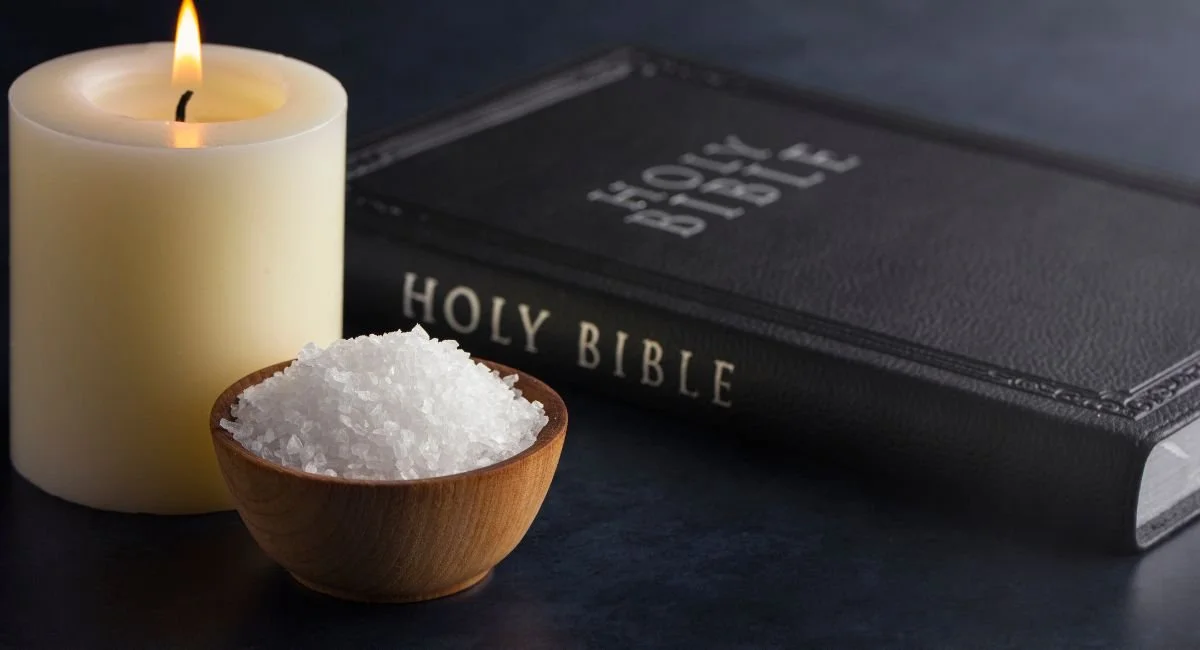
Relevant Scripture on Salt & Light
Genesis 1:3-5 . . . And God said, “Let there be light,” and there was light. God saw that the light was good, and he separated the light from the darkness. God called the light “day,” and the darkness he called “night.” And there was evening, and there was morning—the first day.
NUmbers 18:19 . . . Whatever is set aside from the holy offerings the Israelites present to the Lord, I give to you and your sons and daughters as your perpetual share. It is an everlasting covenant of salt before the Lord for both you and your offspring.
Ezekiel 43:24 . . . You are to present them before the Lord, and the priests are to sprinkle salt on them and sacrifice them as a burnt offering to the Lord.
2 Chronicles 13:5 . . . Don’t you know that the Lord, the God of Israel, has given the kingship of Israel to David and his descendants forever by a covenant of salt?
John 1:1-14 . . . In the beginning was the Word, and the Word was with God, and the Word was God. He was with God in the beginning. Through him all things were made; without him nothing was made that has been made. In him was life, and that life was the light of men. The light shines in the darkness, but the darkness has not understood it.
There came a man who was sent from God; his name was John. He came as a witness to testify concerning that light, so that through him all men might believe. He himself was not the light; he came only as a witness to the light. The true light that gives light to every man was coming into the world.
He was in the world, and though the world was made through him, the world did not recognize him. He came to that which was his own, but his own did not receive him. Yet to all who received him, to those who believed in his name, he gave the right to become children of God— children born not of natural descent, nor of human decision or a husband’s will, but born of God.
John 8:12 . . . When Jesus spoke again to the people, he said, ‘I am the light of the world. Whoever follows me will never walk in darkness, but will have the light of life.”
John 12:46 . . . I have come into the world as a light, so that no one who believes in me should stay in darkness.
Matthew 5:13-16 . . . “You are the salt of the earth. But if the salt loses its saltiness, how can it be made salty again? It is no longer good for anything, except to be thrown out and trampled underfoot.
“You are the light of the world. A town built on a hill cannot be hidden. Neither do people light a lamp and put it under a bowl. Instead they put it on its stand, and it gives light to everyone in the house. In the same way, let your light shine before others, that they may see your good deeds and glorify your Father in heaven.
Mark 9:49 (NLT) . . . Salt is good for seasoning. But if it loses its flavor, how do you make it salty again? You must have the qualities of salt among yourselves and live in peace with each other.
Colossians 4:6 . . . Let your conversation be always full of grace, seasoned with salt, so that you may know how to answer everyone.
Salt & Light
Sermon By James Laurence (2/3/2023)
Check out his blog at https://mypastoralponderings.com
You are the salt of the earth, Jesus tells us in today’s gospel reading. I have been thinking a lot about salt this week. I even read the introduction of a New York Times bestselling book on the history of salt called “Salt: A World History.” Salt, Mark Kurlansky reminds us, is the only rock that we eat, and its importance has shaped civilization in all sorts of important ways. We think of salt as something that we put on foods to give them a little more flavor, but the author of this book reminds us that “from the beginning of civilization until about 100 years ago, salt was one of the most sought-after commodities in human history.”
When Jesus tells us that we are the salt of the earth, he is telling us far more than might at first think. The people who first heard Jesus say this would have thought about it quite differently. So I want to share with you this morning some of what they would have thought about when they were called the salt of the earth. And what that means for us.
The Value of Salt
First, it is hard for us to realize just how valuable salt was back in the time when Jesus walked the earth. Salt is so common these days. When you go to a grocery store, chances are that salt will be one of the cheaper things that you buy. But that was not the case in Jesus’ time. Salt was much harder to obtain back then. And much more valuable.
And salt was more important back then, too, because of its value as a preservative. Before there was electricity and refrigerators, salt was one of the main ways to preserve food. In fact, salt was so valuable in Jesus’s time that Roman soldiers were sometimes paid with special salt rations. That is where our word, “salary,” actually comes from. It’s also why, when someone is not doing their job, we sometimes say “they are not worth their salt.” There was even a common saying in Rome around Jesus’ time, that “there is nothing more useful than sun and salt.”
So, to be told that we are the salt of the earth is to be told that we are very valuable, and very useful. The world needs us. And for whatever mysterious reason, Jesus has decided that he needs us, too. As the salt of the earth, we are both valuable and useful, to God, and to God’s world.
But Salt Doesn’t Exist for Itself
But there is another important quality of salt. It is valuable and useful, yes. But not by itself. Salt is no good on its own. It doesn’t exist for itself. It’s kind of obvious when you think about it, but salt is always used for something else. The salt shaker on the table is not the meal. It is simply there to help flavor the meal. Salt doesn’t exist for itself. And that’s true for us as Christians. Yes, we are valuable. We are important. But not for ourselves.
As Christians, we are best serving our purpose when we are living for Jesus, and for others, not for ourselves. In fact, you could even say that the church is only really doing what it was created to do when it is doing it for others. And that’s true for all of Jesus’ disciples. We are very important to the kingdom, but only when we exist for more than ourselves. Only when we exist for Jesus. And only when we are willing to be the salt, not the main course.
He Must Increase, But I Must Decrease
I think that John the Baptist is a great example of this. He was a salty guy, to be sure. But he knew that he didn’t exist for himself. He existed to prepare the way for Jesus. And once Jesus came on the scene, John knew that ministry was complete. As he said about Jesus in John 3, “He must increase, but I must decrease.”
And it’s true for us, too. Jesus must increase. We must decrease. We are the salt, not the food. Jesus is the food. We are just trying to preserve it and make it taste better. And if we are not doing that, then we have lost our saltiness. We have lost our mission. But when we devote our lives to Jesus, and to the world, then we are truly being the salt of the earth. And then, I suppose you might say, we are truly “worth our salt” as disciples.
The Light of the World
There is nothing more useful than sun and salt, the old Roman saying goes. And in today’s gospel reading, Jesus calls us both the salt of the earth and the light of the world. It is quite a compliment, to be called the salt of the earth. But maybe even more of one to be called the light of the world. In the Gospel of John, Jesus says that he himself is the light of the world. And yet, here in the Sermon on the Mount, Jesus tells us that we are the light of the world.
Think for a minute of how much more valuable light was in Jesus’s time. Before electricity. Salt was more valuable, but so was light. Back then, you couldn’t just walk into a room and flip a switch and turn on the light. We almost take light for granted these days. But to be told that we are the light of the world is to be told that we are extremely important, and very valuable.
Jesus calls us to let our light shine, both in the church and in the community. And he challenges us not to put our light under the bushel basket. We all have a little light to share with our world. You might not think that you have much to offer. You don’t have much time. No obvious talent. To say nothing of your treasure, or lack thereof. But the Bible tells us that every one of us has exactly enough to let our light shine in this world. God has given to us exactly what God needs from us. Every light matters. Every person counts. And even the smallest light is a welcome sight in a dark place.
Can we agree that there is some darkness in the world today? Just as there has always been? We live in a broken and sinful world. It can be a fearful place. A discouraged place. A skeptical, angry, frustrated place. But the amazing thing about light, is that the darker a place is, the less light is needed! The smallest flashlight or candle can light up a dark room. No matter how small your light is, it is exactly what this world needs.
So, Jesus says to us all, let your light shine before others, so that they may see your good works and give glory to your Father in heaven. We use these well-known words at every baptism, to remind us that every baptized Christian can do this. We can all bring glory to God simply by letting our light shine. The smallest act of kindness, the simplest gesture of hospitality and welcome, the humblest sharing of our time or talent – these all give glory to God.
We don’t have to change the world to give glory to God. We don’t have to fix all the problems of our world. We just need to let our light shine. And that will bring glory to God.
I like how the great preacher, Charles Spurgeon put it, when he said:
“The Bible is not the light of the world, it is the light of the Church. But the world does not read the Bible, the world reads Christians! ‘You are the light of the world.’”
The world reads Christians, not the Bible. So we must be the light of the world. As Jesus tells us that we are.
Reflecting the Light
Now, this can sometimes seem a little overwhelming, can’t it? We can feel like if we are the light of the world, the world’s not going to get very bright. Because our little light can seem, well, little. How can we be the light of the world? We’re not Jesus. He is the true light of the world. So how can we do that?
I find it encouraging, when I feel this way, to look at the moon. When the moon is full, as it is this weekend, and the sky is clear, it is absolutely amazing to see how bright the moon can be. The moon can light up a dark night, that’s for sure. But the truth is that even when the moon is at its brightest, it is not providing any light of its own. All it’s really doing is reflecting the light of the sun. And I find that very encouraging. Because that is exactly what I believe we are doing when we are being the light of the world. We’re not actually providing any light of our own. We’re simply reflecting the light of the son. But when we are doing that well, when we are being fully ourselves, the disciples of Jesus that God has called us to be, it is amazing how much light we can offer to the world. And the darker the world around us, the more important the light.
Our world certainly needs a little light these days. And Jesus tells us that being a disciple means providing this light. You are the light of the world, he says. You and I are called to reflect his light into the darkness of the world. Called to let our light shine, but not our light at all – his light reflected through us; through our words, our deeds, our good works. Called to let his light shine through our lives, so that others may see our good works and glorify our Father in heaven.
Closing
You are the salt of the earth … You are the light of the world …
That’s what Jesus tells us today. But you know what he doesn’t tell us? He doesn’t tell us to be the salt of the earth or the light of the world. He tells us that we already are. Because we are his disciples.
All we have to do, in other words, to be the salt and the light is to follow Jesus. We don’t have to be the meal. We just have to preserve the meal, and season it. Jesus himself is the meal. And we don’t have to be the light, either. We just have to reflect it. Jesus is the light of the world.
So, let’s not lose our saltiness. And let’s not hide our light. Because the world needs both now as much as it ever has. And Jesus is counting on us all, to be the salt of the earth, and the light of the world. To the glory of God. Amen.