INTRODUCTION
The Bible is far more than a book to be studied; it claims to be the living Word of God, given to reveal His character, His purposes, and His incredible love for us. In the Preface and Introduction to his paraphrased translation of the Bible titled “The Message”, Eugene Peterson reminds us that Scripture is meant to move beyond our minds and into our hearts and daily lives. Whether we are reading familiar passages or encountering God's Word for the first time, we are invited to listen carefully and allow His truth to shape and transform us. The Bible is not simply a book about God; it is God's personal invitation to know and trust Him.
Peterson encourages us to approach Scripture not merely as students seeking information, but as people entering into a conversation with the living God. As we read, God speaks through His Word, revealing truths we could never discover on our own. He meets us in the realities of everyday life, including our struggles, disappointments, failures, and joys. Scripture does not promise an easy or trouble-free life, but it reveals a God whose grace, mercy, and saving love are at work even in the midst of our broken world. The important question is not simply, "What does this passage mean?" but also, "How is God calling me to live in response to what He has said?"
May we approach God's Word, in whatever translation, with open hearts, attentive minds, and a willingness to be changed. May we not simply read the Scriptures for knowledge, but listen for God's voice, trust His promises, and allow His truth to guide our thoughts, words, and actions. May the Lord bless you as you read, give you wisdom as you listen, deepen your faith as you trust Him, and fill your life with the grace and joy that come from walking daily in His Word. Amen.
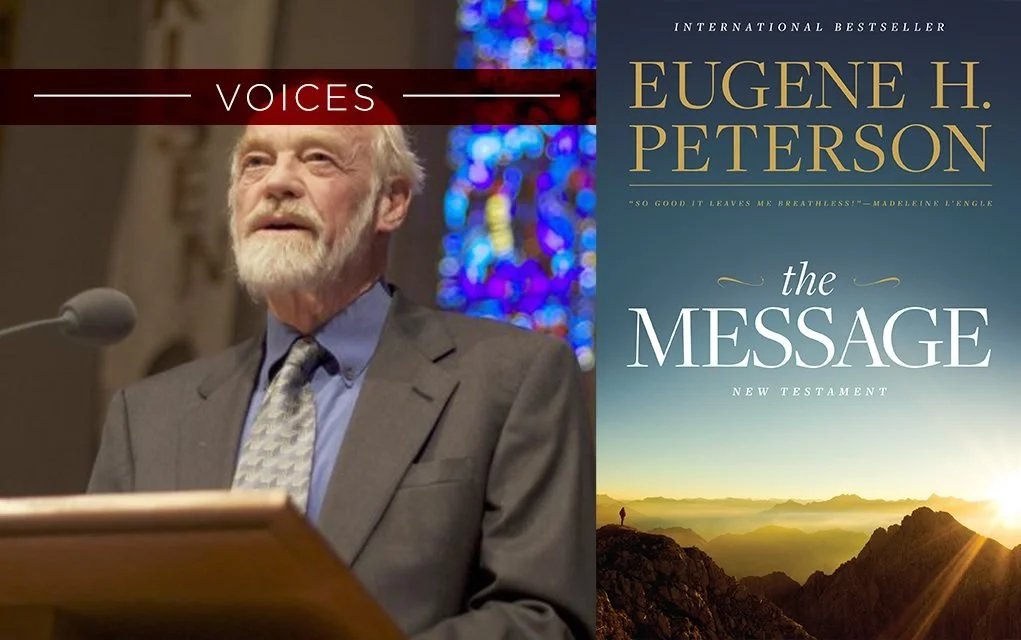
Preface to The Message
By Eugene Peterson
If there is anything distinctive about The Message, perhaps it is because the text is shaped by the hand of a working pastor. For most of my adult life I have been given a primary responsibility for getting the message of the Bible into the lives of the men and women with whom I worked. I did it from pulpit and lectern, in home Bible studies and at mountain retreats, through conversations in hospitals and nursing homes, over coffee in kitchens and while strolling on an ocean beach. The Message grew from the soil of forty years of pastoral work.
As I worked at this task, this Word of God, which forms and transforms human lives, did form and transform human lives. Planted in the soil of my congregation and community the seed words of the Bible germinated and grew and matured. When it came time to do the work that is now The Message, I often felt that I was walking through an orchard at harvest time, plucking fully formed apples and peaches and plums from laden branches. There’s hardly a page in the Bible I did not see lived in some way or other by the men and women, saints and sinners, to whom I was pastor—and then verified in my nation and culture.
I didn’t start out as a pastor. I began my vocational life as a teacher and for several years taught the biblical languages of Hebrew and Greek in a theological seminary. I expected to live the rest of my life as a professor and scholar, teaching and writing and studying. But then my life took a sudden vocational turn to pastoring in a congregation.
“You have your heads in your Bibles constantly because you think you’ll find eternal life there. But you miss the forest for the trees. These Scriptures are all about me! And here I am, standing right before you, and you aren’t willing to receive from me the life you say you want.”
I was now plunged into quite a different world. The first noticeable difference was that nobody seemed to care much about the Bible, which so recently people had been paying me to teach them. Many of the people I worked with now knew virtually nothing about it, had never read it, and weren’t interested in learning. Many others had spent years reading it but for them it had gone flat through familiarity, reduced to clichés. Bored, they dropped it. And there weren’t many people in between. Very few were interested in what I considered my primary work, getting the words of the Bible into their heads and hearts, getting the message lived. They found newspapers and magazines, videos and pulp fiction more to their taste.
Meanwhile I had taken on as my life work the responsibility of getting these very people to listen, really listen, to the message in this book. I knew I had my work cut out for me.
I lived in two language worlds, the world of the Bible and the world of Today. I had always assumed they were the same world. But these people didn’t see it that way. So out of necessity I became a “translator” (although I wouldn’t have called it that then), daily standing on the border between two worlds, getting the language of the Bible that God uses to create and save us, heal and bless us, judge and rule over us, into the language of Today that we use to gossip and tell stories, give directions and do business, sing songs and talk to our children.
And all the time those old biblical languages, those powerful and vivid Hebrew and Greek originals, kept working their way underground in my speech, giving energy and sharpness to words and phrases, expanding the imagination of the people with whom I was working to hear the language of the Bible in the language of Today and the language of Today in the language of the Bible.
I did that for thirty years in one congregation. And then one day (it was April 30, 1990) I got a letter from an editor asking me to work on a new version of the Bible along the lines of what I had been doing as a pastor. I agreed. The next ten years was harvest time. The Message is the result.
The Message is a reading Bible. It is not intended to replace the excellent study Bibles that are available. My intent here (as it was earlier in my congregation and community) is simply to get people reading it who don’t know that the Bible is readable at all, at least by them, and to get people who long ago lost interest in the Bible to read it again. But I haven’t tried to make it easy—there is much in the Bible that is hard to understand. So at some point along the way, soon or late, it will be important to get a standard study Bible to facilitate further study. Meanwhile, read in order to live, praying as you read, “God, let it be with me just as you say.”
Introduction to The Message
By Eugene Peterson
Reading is the first thing, just reading the Bible. As we read we enter a new world of words and find ourselves in on a conversation in which God has the first and last words. We soon realize that we are included in the conversation. We didn’t expect this. But this is precisely what generation after generation of Bible readers do find: The Bible is not only written about us but to us. In these pages we become insiders to a conversation in which God uses words to form and bless us, to teach and guide us, to forgive and save us.
We aren’t used to this. We are used to reading books that explain things, or tell us what to do, or inspire or entertain us. But this is different. This is a world of revelation: God revealing to people just like us—men and women created in God’s image—how God works and what is going on in this world in which we find ourselves. At the same time that God reveals all this, God draws us in by invitation and command to participate in God’s working life. We gradually (or suddenly) realize that we are insiders in the most significant action of our time as God establishes his grand rule of love and justice on this earth (as it is in heaven). “Revelation” means that we are reading something we couldn’t have guessed or figured out on our own. Revelation is what makes the Bible unique.
And so just reading this Bible, The Message, and listening to what we read, is the first thing. There will be time enough for study later on. But first, it is important simply to read, leisurely and thoughtfully. We need to get a feel for the way these stories and songs, these prayers and conversations, these sermons and visions, invite us into this large, large world in which the invisible God is behind and involved in everything visible and illuminates what it means to live here—really live, not just get across the street. As we read, and the longer we read, we begin to “get it”—we are in conversation with God. We find ourselves listening and answering in matters that most concern us: who we are, where we came from, where we are going, what makes us tick, the texture of the world and the communities we live in, and—most of all—the incredible love of God among us, doing for us what we cannot do for ourselves.
Through reading the Bible, we see that there is far more to the world, more to us, more to what we see and more to what we don’t see—more to everything!—than we had ever dreamed, and that this “more” has to do with God.
This is new for many of us, a different sort of book—a book that reads us even as we read it. We are used to picking up and reading books for what we can get out of them: information we can use, inspiration to energize us, instructions on how to do something or other, entertainment to while away a rainy day, wisdom that will guide us into living better. These things can and do take place when reading the Bible, but the Bible is given to us in the first place simply to invite us to make ourselves at home in the world of God, God’s word and world, and become familiar with the way God speaks and the ways in which we answer him with our lives.
Our reading turns up some surprises. The biggest surprise for many is how accessible this book is to those who simply open it up and read it. Virtually anyone can read this Bible with understanding. The reason that new translations are made every couple of generations or so is to keep the language of the Bible current with the common speech we use, the very language in which it was first written. We don’t have to be smart or well-educated to understand it, for it is written in the words and sentences we hear in the marketplace, on school playgrounds, and around the dinner table. Because the Bible is so famous and revered, many assume that we need experts to explain and interpret it for us—and, of course, there are some things that need to be explained. But the first men and women who listened to these words now written in our Bibles were ordinary, everyday, working-class people. One of the greatest of the early translators of the Bible into English, William Tyndale, said that he was translating so that “the boy that driveth the plough” would be able to read the Scriptures.
One well-educated African man, who later became one of the most influential Bible teachers in our history (Augustine), was greatly offended when he first read the Bible. Instead of a book cultivated and polished in the literary style he admired so much, he found it full of homespun, earthy stories of plain, unimportant people. He read it in a Latin translation full of slang and jargon. He took one look at what he considered the “unspiritual” quality of so many of its characters and the everydayness of Jesus, and contemptuously abandoned it. It was years before he realized that God had not taken the form of a sophisticated intellectual to teach us about highbrow heavenly culture so we could appreciate the finer things of God. When he saw that God entered our lives as a Jewish servant in order to save us from our sins, he started reading the Book gratefully and believingly.
Some are also surprised that Bible reading does not introduce us to a “nicer” world. This biblical world is decidedly not an ideal world, the kind we see advertised in travel posters. Suffering and injustice and ugliness are not purged from the world in which God works and loves and saves. Nothing is glossed over. God works patiently and deeply, but often in hidden ways, in the mess of our humanity and history. Ours is not a neat and tidy world in which we are assured that we can get everything under our control. This takes considerable getting used to—there is mystery everywhere. The Bible does not give us a predictable cause-effect world in which we can plan our careers and secure our futures. It is not a dream world in which everything works out according to our adolescent expectations—there is pain and poverty and abuse at which we cry out in indignation, “You can’t let this happen!” For most of us it takes years and years and years to exchange our dream world for this real world of grace and mercy, sacrifice and love, freedom and joy—the God-saved world.
Yet another surprise is that the Bible does not flatter us. It is not trying to sell us anything that promises to make life easier. It doesn’t offer secrets to what we often think of as prosperity or pleasure or high adventure. The reality that comes into focus as we read the Bible has to do with what God is doing in a saving love that includes us and everything we do. This is quite different from what our sin-stunted and culture-cluttered minds imagined. But our Bible reading does not give us access to a mail-order catalog of idols from which we can pick and choose to satisfy our fantasies. The Bible begins with God speaking creation and us into being. It continues with God entering into personalized and complex relationships with us, helping and blessing us, teaching and training us, correcting and disciplining us, loving and saving us. This is not an escape from reality but a plunge into more reality—a sacrificial but altogether better life all the way.
God doesn’t force any of this on us: God’s word is personal address, inviting, commanding, challenging, rebuking, judging, comforting, directing—but not forcing. Not coercing. We are given space and freedom to answer, to enter the conversation. For more than anything else the Bible invites our participation in the work and language of God.
As we read, we find that there is a connection between the Word Read and the Word Lived. Everything in this book is live-able. Many of us find that the most important question we ask as we read is not “What does it mean?” but “How can I live it?” So we read personally, not impersonally. We read in order to live our true selves, not just get information that we can use to raise our standard of living. Bible reading is a means of listening to and obeying God, not gathering religious data by which we can be our own gods.
You are going to hear stories in this Book that will take you out of your preoccupation with yourself and into the spacious freedom in which God is working the world’s salvation. You are going to come across words and sentences that stab you awake to a beauty and hope that will connect you with your real life.
Be sure to answer.
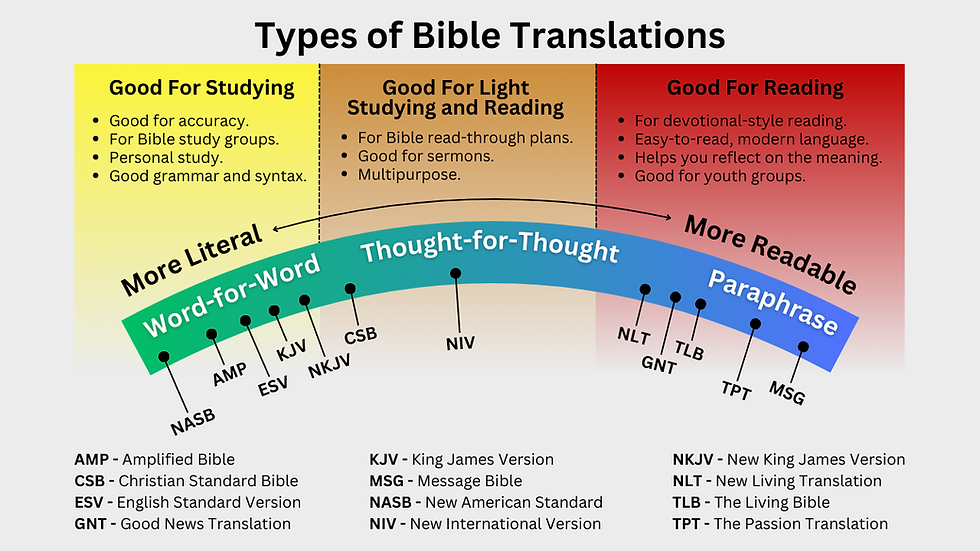
There are three main types of Bible translations: word-for-word, thought-for-thought, and paraphrase. A word-for-word translation attempts to translate each Hebrew or Greek word into a corresponding English word. However, some consider a word-for-word translation harder to understand, particularly when it comes to figures of speech that are not used in modern culture. Two examples of word-for-word translations are the King James Version and the New King James Version.
The thought-for-thought translations seek to express the meaning of each sentence or paragraph from the original language in simple up-to-date English without being tied to translating every word. As such, these types of translations should not be exclusively relied on for doctrinal study. The New International Version is perhaps the most well-known of the thought-for-thought translations.
A paraphrased translation has the primary goal of conveying the Bible in a simple, easy-to-understand language without regard to word-for-word or even thought-for-thought expressions of the original languages. The authors often exercise "poetic license," leaving great room for personal religious ideas.
I personally use the NIV for my daily reading, but refer to several other translations frequently, including the Message, when I want to compare translations of a particular verse or section of Scripture.
The following is an example of translations of the very familiar John 3:16-17 from literal to paraphrased versions. You can see they all convey the same liberating truth:
NASB . . . For God so loved the world, that He gave His only Son, so that everyone who believes in Him will not perish, but have eternal life. For God did not send the Son into the world to judge the world, but so that the world might be saved through Him.
ESV . . . For God so loved the world, that he gave his only Son, that whoever believes in him should not perish but have eternal life. For God did not send his Son into the world to condemn the world, but in order that the world might be saved through him.
NKJV . . . For God so loved the world that He gave His only begotten Son, that whoever believes in Him should not perish but have everlasting life. For God did not send His Son into the world to condemn the world, but that the world through Him might be saved.
NIV . . . For God so loved the world that he gave his one and only Son, that whoever believes in him shall not perish but have eternal life. For God did not send his Son into the world to condemn the world, but to save the world through him.
NLT . . . For this is how God loved the world: He gave his one and only Son, so that everyone who believes in him will not perish but have eternal life. God sent his Son into the world not to judge the world, but to save the world through him.
Message . . . This is how much God loved the world: He gave his Son, his one and only Son. And this is why: so that no one need be destroyed; by believing in him, anyone can have a whole and lasting life. God didn’t go to all the trouble of sending his Son merely to point an accusing finger, telling the world how bad it was. He came to help, to put the world right again.
Read the Bible in a Year
https://www.christianity.com/bible/year/
Reading the Bible daily not only helps you grow in your faith and walk with Jesus Christ, but will be an amazing source of encouragement throughout your day. You can read the Bible in one year by following one of the Bible reading plans found in the link above.
Start Scripture reading on the 1st or 15th of any month, or choose any date to customize your plan. However, starting your reading plan on January 1st would be a great way to begin the new year. I highly recommend embarking on this journey using a Study Bible or Life Application Bible as these will provide additional context, explanations, insights that help with difficult passages, and also practical application for our lives. My wife uses the NIV Life Application Bible and I read on my laptop using Logos software which includes a number of different translations and commentaries.
Don't let the idea of reading through Scripture feel overwhelming. With daily reading broken into manageable portions, you'll discover the beauty and power of God's Word one day at a time. The following are the reading plans offered on the website above. If this is your first attempt to read the entire Bible I recommend using either the New then Old or Old and New reading plans.
Beginning to End: Read the Bible from start to finish, from Genesis to Revelation.
Chronological: Read the Bible as its events occurred in real time. For example, Job lived sometime after the beginning of creation (Genesis 1) but before Abraham was born (Genesis 12). As a result, the Book of Job is integrated into the Book of Genesis.
Historical: Read the books of the Bible as they were written historically, according to the estimated date of their writing.
New then Old: Read through the New Testament first, then read through the Old Testament.
Old and New: Each day includes a passage from both the Old Testament and New Testament.
Benefits of Reading the Bible with Friends
Finally, If you can find one or more friends who will commit to do this with you, I guarantee the experience will be one of the most meaningful and spiritually rewarding things you can do together. The following are some of the benefits:
1. Growing closer to God together: Reading Scripture consistently helps you understand God's character, His promises, His faithfulness, and His purpose for your life. Over a year, you begin to see the bigger picture of God's story.
2. Accountability and consistency: It's easy to miss a day or lose momentum when reading alone. Knowing that friends are on the same journey encourages you to stay committed, even when life gets busy.
3. Deeper friendships: Sharing what you're learning creates a different kind of friendship. Instead of only discussing everyday activities, you begin sharing your faith, struggles, questions, and spiritual growth.
4. Seeing Scripture through different perspectives: One of the greatest benefits is discovering how differently the same passage can speak to each person. A friend may notice something you've overlooked, helping you gain a richer understanding of God's Word.
5. Encouragement during difficult seasons: There will be times when someone is discouraged, struggling, grieving, or facing uncertainty. Reading Scripture together provides opportunities to remind one another of God's promises and offer encouragement.
6. Learning the Bible as one complete story: Reading from Genesis through Revelation helps you understand how the Old and New Testaments connect and how God's plan unfolds throughout history.
7. Developing a lifelong spiritual discipline: A year of consistent reading can establish a habit that continues long after the reading plan ends.
8. More meaningful conversations: You may find yourselves discussing things like: What does this passage teach us about God? What can we learn from the people in this story? Is there something in our lives we need to change? How can we put this Scripture into practice?
9. Praying for one another
Your reading group can become a small prayer community. You learn what is happening in each other's lives and can pray specifically for one another.
10. Creating memories that have eternal significance
At the end of the year, you'll have something special to look back on: a shared journey through God's Word that may have strengthened your faith and your friendships for years to come.
If you choose to embark on this adventure, here are a few questions you might consider discussing with your friend(s) each week:
What did you learn about God's character this week?
Was there a particular verse that spoke to you?
Did anything surprise, challenge, or confuse you?
Is God showing you something you need to apply to your life?
How can we pray for each other this week?
Imagine what could happen over the next 365 days if three friends committed to reading God's Word together. You would read the stories of creation, faith, courage, forgiveness, obedience, redemption, and ultimately the life and teachings of Jesus, our Savior. You would celebrate the passages that inspire you, wrestle with the ones you don't understand, and encourage each other through the ones that speak directly to your lives. At the end of the year, you won't just have read the Bible. You'll have grown together in your understanding of God and His Word and, if you are like me and my wife, you will find that you are excited to do it again and again.