Introduction
Sometimes the most meaningful moments in our lives begin with a reluctant decision. In this touching story, a father and his children set out on a simple outing to a remote beach, unaware that their adventure will lead them to a helpless creature in need of rescue. Through their efforts to save an oil-covered loon, the family discovers the importance of compassion, teamwork, and being willing to act when faced with another living being's suffering. It’s more than a story about rescuing a bird. It is a reminder that God, in His wonderful providence, gives us opportunities to make a difference when we least expect them.
In this story Arthur Gordon, from his book A Touch of Wonder, reminds us how close we often come to missing moments in life that matter most. A reluctant parent, three eager children, and an unexpected discovery on a windswept beach reveal a deep truth: that wonder isn’t typically found in our best laid plans, but in the choices we almost didn’t make.
“Lord of all things, whose wondrous gifts to man Include the shining symbols known as words, Grant that I may use their mighty power only for good. Help me to pass on small fragments of Your wisdom, truth, and love. Teach me to touch the unseen, lonely heart with laughter, or the quick release of tears. Let me portray the courage that endures defiant in the face of pain or death; the kindness and the gentleness of those who fight against the anger of the world; the beauty hidden in the smallest things; the mystery, the wonder of it all… Open my ears, my eyes; unlock my heart. Speak through me, Lord, if it be Your will. Amen.”
By Arthur Gordon
From A Touch of Wonder
Almost— almost— we didn’t go. The afternoon was right for it: clear, not cold, a veil of sand blowing off the lion-colored dunes and whispering into the restless sea along our strip of Georgia coast. And all the three youngest children wanted was for me to take them across the river and through the winding tidal creeks to the deserted beaches farther south where they could look for shells or follow coon tracks or gather sea oats or watch for wild goats.
Simple, really: a fifteen-minute run in our little out-board skiff. But the tide was out, and the boat would be stranded, and getting it into the water would be a struggle. Besides, there was a televised football game that promised a degree of entertainment with much less effort. So I had said, “We’ll see,” in the vague tone that parents use. And the children knew from long experience that this means no.
But then I saw their forlorn faces, as they huddled in a disconsolate triangle.
“All right,” I said, feeling noble and exasperated and self-sacrificing. “All right. We’ll go. But just for a little while.”
Faces brightened. “Can we take Tony?” Tony is a Shetland sheep dog, unacquainted with sheep, who loves boats. “I guess so,” I said. And automatically, “Wear something warm.”
Down at the river, we dragged the boat to the water, getting muddy feet. The engine coughed morosely for a while, then picked up with a splendid roar and drove us through the chop so fast that spray soaked everyone, including the sheltie, who stood in the bow, ears pinned back by the wind, tongue waving with delight.
For three minutes the skiff pranced and bucked in the river. Then suddenly we were in the sheltered network of creeks, skimming around silver corners, flying down amber aisles of marsh grass where blackbirds flared in silent explosions, past dead trees pointing like witches, finally into a broad estuary where the engine bellowed happily at full throttle.
Ahead of us now I could see leaping tongues of surf above the strip of barrier beach, and far away on some high dunes to the southeast a handful of goats moving slowly with a kind of lordly assurance as if the realities we knew could never touch them. I pointed, wordless against the clamor of the engine. Everyone looked and nodded gravely. The world had not changed. The goats were still there.
The skiff eased into a quiet cove. I cut the engine, and at once the surf thundered in our ears. The dog sprang ashore and sank to his astonished chin in damp and porous sand. The children floundered after him, carrying the anchor as they had been taught. A fearsome crew, really. Kinzie, thirteen, was wearing blue jeans scissored off raggedly at the knee; on her head a once-white sailor hat with down-turned brim was pulled so low that she looked like a candle being snuffed. Dana, eleven, wore an old cashmere sweater of mine, full of holes, with sleeves so long that she seemed to have no hands at all, but her blue eyes were the color of seawater on a cloudy day, and her hair was a mermaid-meteor in the wind. Mac, eight, wore a sweatshirt with an improbable-looking bulldog stenciled on it. As always, he needed a haircut.
They raced away through the sea oats, so many things to find or do (and take for granted): fiddler crabs to catch and carry home to be harnessed with thread and coaxed to pull paper chariots; marsh swallows’ nests, sometimes with eggs; skeletons of rowboats resting their weary bones against the dunes; floats from seine nets, starfish and sand dollars, conchs’ eggs and horseshoe crabs, all flung carelessly by the lavish hand of the sea. I watched them go with tolerance and amusement. I, too, a taker-for-granted, and with less excuse— none, really, except that most of the time that’s what all parents tend to be where their children are concerned.
I was tilting the engine to keep the propeller out of the sand when I heard the sheltie barking, hysterical high-pitched yelps coming fast downwind. A moment later Mac came rushing back, eyes dark with excitement. “Daddy, come quick….. a bird, a big one, maybe a goose…. he can’t fly… he’s hurt or something… hurry!”
Through the soft sand, heavy-footed, into the dune grasses, up over the shallow rise, and there on the beach, shadows against the sun dazzle, the two girls and the sheltie surrounding a strange, penguin-like silhouette that lurched and flopped awkwardly, long neck and javelin bill lunging defiantly at the dog. I came close and saw the webbed feet set too far back for walking, the sleek head, and the angry eyes. It was a loon, feathers matted into a hopeless, tarry mass. Looking at it, I felt something wince inside me: The worst that can happen to any creature is to be made incapable of doing the thing it was created to do.
“What’s wrong with him?” cried Dana, not far from tears.
“He got too close to civilization,” I said slowly. And I told them how sometimes a ship discharges fuel oil that makes a heavy slick on the ocean, and how a diving loon might come up under this deadly film and have its plumage so saturated that it could not fly.
“Will he be all right?” Mac asked fearfully. “What will happen to him?”
I knew that after sundown a roving raccoon would answer these questions, and that nature’s solution would be better than slow death by starvation, but I could not bring myself to say so.
“There’s a towel in the boat,” said Kinzie, the practical one. “Maybe we can wipe him off.”
“He’ll bite us!” cried Mac with delight and terror.
“Not very hard,” I said. “Get the towel. We’ll give it a try.”
But even when I held the proud head so that the dagger bill could not strike, and pinioned the strong but useless wings, the towel made little impression. “We need something to dissolve the oil,” I said finally. “Mineral spirits, maybe.”
“There’s some at home,” both girls said at once.
“Let’s take him home!” shouted their brother, deliriously. “We’ll clean him up and put him in the bathtub and feed him some dog food and make him a pet!”
“He’s a wild bird,” I said, some obscure parental resistance rising up in me. “He doesn’t want to live in a bathtub and be a pet. Besides, I’m not sure we can get this stuff off.”
“But we found him,” Kinzie said a little desperately. “We can’t just leave him here to die.”
We found him, that was true— or perhaps he found us. Either way, out of all the millions of possible space-time curves, something had caused his and ours to intersect in this unlikely place. Chance? Of course, but still…… “Who’ll hold him?” I asked a bit grumpily. “I can’t run a boat with one hand and hang onto a wild loon with the other.”
“I’ll hold him,” all three of them said instantly. And they did (or at least the older girl did, the others close on either side), the bird wrapped firmly with a corner of the towel over its head (which seemed to quiet it), and the sheltie crouched, disapproving and dejected, at my feet.
“We’ve got a loon!” Mac shrieked to his unsuspecting mother as we entered the house. “An oily one! We’re going to wash him in the bathtub!” He hesitated, his masculine radar picking up dubious vibrations. “But then,” he added more quietly, “we’re going to let him go.”
The next hour was chaotic. Preparations were immense: sponges, cotton pads, warm water, cool water, soaps, elixirs and combinations of elixirs. Theories were advanced and demolished. Advice was endless. The loon, unappreciative, bit everyone at least twice. And traces of oil clung grimly. But finally, when the last rinse disappeared from the stained tub, the dark feathers were parallel and distinguishable, and most of the weighted clumsiness was gone.
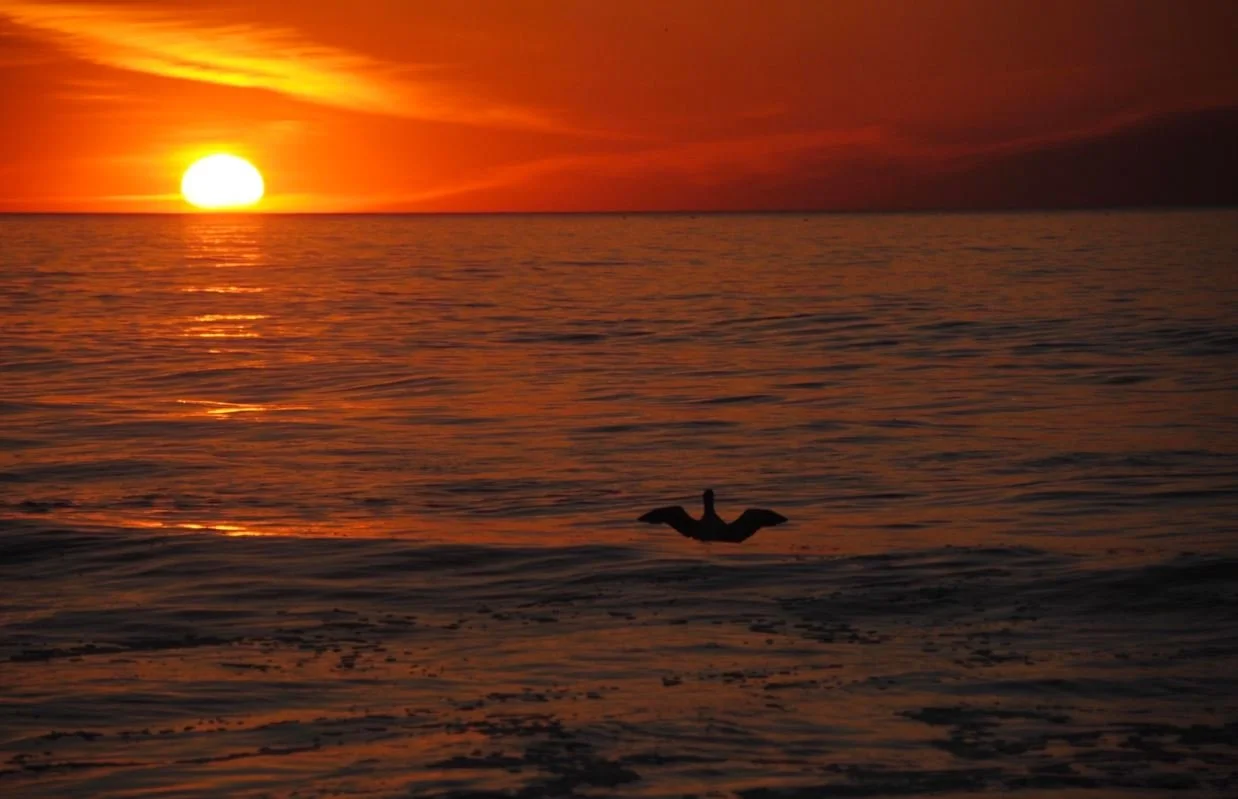
We took him, wrapped in a clean towel, through the living room, down the porch steps, across the dusky beach to the ocean’s edge. When we put him in the water, he bobbed uncertainly for a moment. He turned his head and raked his back feathers swiftly with his bill, as if to align them properly. Then he started swimming strongly out to sea, toward the distant sandbar where shorebirds were settling for the night.
“Why doesn’t he fly?” Dana asked worriedly.
“I think his feathers are too wet,” I said. “When the sun dries them tomorrow, he may be all right.”
The sheltie, spirits revived, went bounding off, and the girls followed him. The boy and I turned back toward the house, crouching in the dunes, its roof line sharp against the western sky. The sand squeaked as he scuffed his feet. “He would have died, wouldn’t he, Daddy?”
“Yes, he would.”
He shook his head slowly. “And we almost didn’t go, remember?” “Yes,” I said.
“Yes, I’ll try to remember.”