When I Am Weak
INTRODUCTION
Several years ago I stumbled on a blog hosted by Michael Spencer (1956–2010), known online as the Internet Monk. He was a Southern Baptist minister, campus chaplain, teacher, and later a highly influential Christian blogger whose authenticity helped console thousands of people struggling in their faith journey. In this powerful essay Michael invites us to consider a truth that is both humbling and deeply comforting: our weakness is not an obstacle to God's grace. Rather it is often the place where His grace is most visible. Instead of hiding our struggles or pretending we have it all together, Michael encourages us to bring our whole selves to Christ, trusting that His strength is made perfect, not in our success, but in our need.
May Michael’s encouraging words and the beautiful eulogy given by his friend, David Head, draw you near to the One who knows you completely, loves you fully, and whose power is made perfect in weakness.
Excerpt from Eulogy for Michael Spencer (1956-2010)
By David Head, Lifelong Friend
Someone once described Mother Teresa’s life as “doing something beautiful for God”. Can I borrow that? Michael lived an honest life for Jesus. Or maybe better– an honest life with Jesus. Michael’s life was his ministry. He let us in on the dynamic of what it means to live with Jesus at the center. I call it honesty. You might call it being confessional or transparent or open or real. If you encountered Michael, you got to see exactly where he was on the journey with Jesus.
There are a lot of people who do that. But what made Michael’s ministry so compellingly powerful was his willingness to share his brokenness, flaws and struggles. He never tried to convince us that he had his act together. He refused to take the easy road of cultivating an on-line image that was heroically certain. He went to the boundaries of safe and predictable faith and stepped over. He was Jacob wrestling with the angel of the Lord through the dark nights of his soul. He expressed his tears and laments, questions and screams at God, fears and failures, doubts and an ambiguity that left you wondering how faith would possibly survive that moment.
A first encounter with that depth of honesty was scary. It left you feeling like a voyeur, with access to something intimate you weren’t supposed to have. But then something happened. Michael’s courageous honesty about the beautiful messes of his own journey with Jesus gave permission for thousands of us to own our own mess with Jesus. To realize that our brokenness, flaws, struggles, fears, and doubts are a part of the normal Christian journey. Because they are a part of life and you do it—all of it—with Jesus. Reality means you confess before God, friends, family and even our churches, “I’m a mess…and I’m with Jesus.” One person said “Michael put words to my own struggles in ways I wished I could but couldn’t. I know I’m not alone in this. His gift is putting himself out there so that we can see and read and shout “Yes! Exactly! Someone understands!”
How could he do that—and why was it so powerful? The grace of Jesus had set Michael free. He knew he was an undeserving recipient of extravagant mercy, and also that “real grace is simply inexplicable, inappropriate, out of the box, out of bounds, offensive, excessive, too much, given to the wrong people and all those things.” By grace, Michael knew that Jesus accepted him and loved no matter what. He had come to know that there really was no condemnation for those in Jesus and when you’re free, darkness loses its bite. When you’re accepted and free, you don’t worry about pleasing people or currying favor or protecting yourself. You simply live, comfortable in your own skin, desperately clinging to Jesus. His honesty changed people because it pointed them to Jesus.
The thing about Jacob’s wrestling was that he emerged limping on the other side. Limping, but still moving forward. Michael showed us that side of grace, too. He possessed an unrelenting curiosity that never tired of exploring the frontiers of God and soul and church and life. Sometimes, the questions he raised made us uncomfortable or angry, but it was part of the journey and the growing. So, he limped and moved forward. He grew weary of battles over worship styles and language and who’s right and who’s winning and Baptist family quarrels, but he kept limping forward. Michael laughed holy laughter at the foolishness of some things that go on in the name of Jesus, but he never grew cynical and kept limping forward. Somehow, there was still joy under the surface and a simple child-like faith that trusted Jesus, a faith that Denise tells us only grew sweetly stronger the weaker his body grew, as he limped towards death.
I last saw Michael a few days before he stopped speaking. Through tears, the last thing he said was “Jesus is all that matters…the gospel and grace is all that matters.” Grace led him this far and grace led Michael home. It makes me sad—and at moments a little angry– that Michael is gone so soon. But like Jesus (John 17:4), Michael glorified God on earth by accomplishing the work God gave him to do. You glorify God by spotlighting Jesus and His grace. Michael said, “If you are going to think about God, go to Jesus and start there, stay there, and end there.” So, he did.
Relevant Scripture
Isaiah 40:29-31 . . . He gives strength to the weary and increases the power of the weak. Even youths grow tired and weary, and young men stumble and fall; but those who hope in the Lord will renew their strength. They will soar on wings like eagles; they will run and not grow weary, they will walk and not be faint.
Luke 5:29-31 . . . When the scribes who were Pharisees saw Jesus eating with these people, they asked His disciples, “Why does He eat with tax collectors and sinners?” On hearing this, Jesus told them, “It is not the healthy who need a doctor, but the sick. I have not come to call the righteous, but sinners.”
Luke 18:9-14 . . . To some who were confident of their own righteousness and looked down on everyone else, Jesus told this parable: “Two men went up to the temple to pray, one a Pharisee and the other a tax collector. The Pharisee stood by himself and prayed: ‘God, I thank you that I am not like other people—robbers, evildoers, adulterers—or even like this tax collector. I fast twice a week and give a tenth of all I get.’ “But the tax collector stood at a distance. He would not even look up to heaven, but beat his breast and said, ‘God, have mercy on me, a sinner.’ “I tell you that this man, rather than the other, went home justified before God. For all those who exalt themselves will be humbled, and those who humble themselves will be exalted.”
1 Corinthians 2:1-5 . . . When I came to you, brothers, I did not come with eloquence or superior wisdom as I proclaimed to you the testimony about God. For I resolved to know nothing while I was with you except Jesus Christ and him crucified. I came to you in weakness and fear, and with much trembling. My message and my preaching were not with wise and persuasive words, but with a demonstration of the Spirit’s power, so that your faith might not rest on men’s wisdom, but on God’s power.
2 Corinthians 12:7-10 . . . To keep me from becoming conceited because of these surpassingly great revelations, there was given me a thorn in my flesh, a messenger of Satan, to torment me. Three times I pleaded with the Lord to take it away from me. But he said to me, “My grace is sufficient for you, for my power is made perfect in weakness.” Therefore I will boast all the more gladly about my weaknesses, so that Christ’s power may rest on me. That is why, for Christ’s sake, I delight in weaknesses, in insults, in hardships, in persecutions, in difficulties. For when I am weak, then I am strong.
Romans 7:18-25 . . . I know that nothing good lives in me, that is, in my sinful nature. For I have the desire to do what is good, but I cannot carry it out. For what I do is not the good I want to do; no, the evil I do not want to do—this I keep on doing. Now if I do what I do not want to do, it is no longer I who do it, but it is sin living in me that does it. So I find this law at work: When I want to do good, evil is right there with me. For in my inner being I delight in God’s law; but I see another law at work in the members of my body, waging war against the law of my mind and making me a prisoner of the law of sin at work within my members. What a wretched man I am! Who will rescue me from this body of death? Thanks be to God—through Jesus Christ our Lord!
When I am Weak
By Michael Spencer, AKA the Internet Monk
The voice on the other end of the phone told a story that has become so familiar to me, I could have almost finished it from the third sentence. A respected and admired Christian leader, carrying the secret burden of depression, had finally broken under the crushing load of holding it all together. As prayer networks in our area begin to make calls and send e-mails, the same questions are asked again and again. “How could this happen? How could someone who spoke so confidently of God, someone whose life gave such evidence of Jesus’ presence, come to the point of a complete breakdown? How can someone who has the answers for everyone one moment, have no answers for themselves the next?”
Indeed. Why are we, after all that confident talk of “new life,” “new creation,” “the power of God,” “healing,” “wisdom,” “miracles,” “the power of prayer,” … why are we so weak? Why do so many “good Christian people,” turn out to be just like everyone else? Divorced. Depressed. Broken. Messed up. Full of pain and secrets. Addicted, needy and phony. I thought we were different.
Evangelicals love a testimony of how screwed up I USED to be. They aren’t interested in how screwed up I am NOW. But the fact is, that we are screwed up. Then. Now. All the time in between and, it’s a safe bet to assume, the rest of the time we’re alive. But we will pay $400 to go hear a “Bible teacher” tell us how we are only a few verses, prayers and CDs away from being a lot better. And we will sit quietly, or applaud loudly, when the story is retold. I’m really better now. I’m a good Christian. I’m not a mess anymore. I’m different from other people.
Please. Call this off. It’s making me sick. I mean that. It’s affecting me. I’m seeing, in my life and the lives of others, a commitment to lying about our condition that is absolutely pathological. Come on. How many nodding “good Christians” have so much garbage sitting in the middle of their lives that the odor makes it impossible to breathe without gagging? How many of us are addicted to something? How many of us are depressed, angry, unforgiving and just plain mean? How many of us are a walking, talking course on basic hypocrisy, because we just can’t look at ourselves in the mirror and admit what a collection of brokenness we’ve become WHILE we called ourselves “good Christians” who want to “witness” to others? Gack. I’m choking just writing this.
Isn’t almost everyone in the Bible screwed up? I mean, don’t the screwed-up people - like Abraham, Jacob, Moses, David, Hosea - outnumber the “good Christians” by about ten to one? And isn’t it true that the more we get to look at a Biblical character close up, the more likely it will be that we’ll see a whole nasty collection of things that Christians say they no longer have to deal with because, praise God! I’m fixed? Not just a few temper tantrums or ordinary lies, but stuff like violence. Sex addictions. Abuse. Racism. Depression. It’s all there, yet we still flop our Bibles open on the pulpit and talk about “Ten Ways to Have Joy That Never Goes Away!”
What was that I heard? “Well….we’re getting better. That’s sanctification. I’ve been delivered!” I suppose some of us are getting better. For instance, my psycho scary temper is better than it used to be. Of course, the reason my temper is better, is that in the process of cleaning up the mess I’ve made of my family with my temper, I’ve discovered about twenty other major character flaws that were growing, unchecked, in my personality. I’ve inventoried the havoc I’ve caused in this short life of mine, and it turns out “temper problem” is way too simple to describe the mess that is me. Sanctification? Yes, I no longer have the arrogant ignorance to believe that I’m always right about everything, and I’m too embarrassed by the general sucktitude of my life to mount an angry fit every time something doesn’t go my way. Getting better? Quite true. I’m getting better at knowing what a wretched wreck I really amount to, and it’s shut me up and sat me down.
I love this passage of scripture. I don’t know why so few believe it, but I love it.
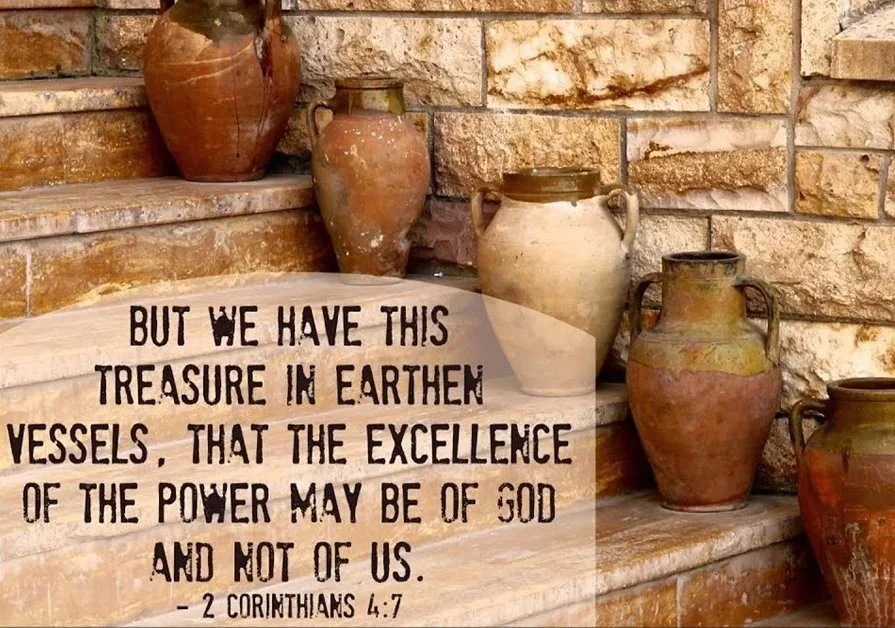
But we have this treasure in jars of clay, to show that the surpassing power belongs to God and not to us. We are afflicted in every way, but not crushed; perplexed, but not driven to despair; persecuted, but not forsaken; struck down, but not destroyed; always carrying in the body the death of Jesus, so that the life of Jesus may also be manifested in our bodies. For we who live are always being given over to death for Jesus’ sake, so that the life of Jesus also may be manifested in our mortal flesh. (2 Corinthians 4:7-11)
Contextual concerns aside, let’s read Paul’s words as a basic “reality board” to the Christian life. We’re dying. Life is full of pain and perplexity. We have Christ, and so, in the future, his life will manifest in us in resurrection and glory. In the present, that life manifests in us in this very odd, contradictory experience. We are dying, afflicted, broken, hurting, confused…yet we hold on to Jesus in all these things, and continue to love him and believe in him. The power of God is in us, not in making us above the human, but allowing us to be merely human, yet part of a new creation in Jesus.
What does this mean?
It means your depression isn’t fixed. It means you are still overweight. It means you are still frightened of dying, reluctant to tell the truth and purposely evasive when it comes to responsibility. It means you can lie, cheat, steal, even do terrible things, when you are ‘in the flesh,” which, in one sense, you always are. If you are a Christian, it means you are frequently miserable, and it means you are involved in a fight for Christ to have more influence in your life than your broken, screwed up, messed up humanity. In fact, the greatest miracle is that with all the miserable messes in your life, you still want to have Jesus as King, because it’s a lot of trouble, folks. It isn’t a picnic.
But he said to me, “My grace is sufficient for you, for my power is made perfect in weakness.” Therefore I will boast all the more gladly of my weaknesses, so that the power of Christ may rest upon me. For the sake of Christ, then, I am content with weaknesses, insults, hardships, persecutions, and calamities. For when I am weak, then I am strong. (2 Corinthians 12:9-10)
Here is even more undeniable, unarguable language. Weaknesses are with me for the whole journey. Paul was particularly thinking of persecutions, but how much more does this passage apply to human frailty, brokenness and hurt? How essential is it for us to be broken, if Christ is going to be our strength? When I am weak I am strong. Not, “When I am cured,” or “When I am successful,” or “When I am a good Christian,” but when I am weak. Weakness - the human experience of weakness - is God’s blueprint for exalting and magnifying his Son. When broken people, miserably failing people, continue to belong to, believe in and worship Jesus, God is happy.
Now, the upper gallery is full of people who are getting upset, certain that this essay is one of those pieces where I am in the mood to tell everyone to go sin themselves up, read Capon and forget about sanctification. You should know me better by now.
The problem is a simple one of semantics. Or perhaps a better way to say it is imagination. How do we imagine the life of faith? What does living faith look like? Does it look like the “good Christian,” “whole person,” “victorious life” version of the Christian life?
As I see it, faith, alive in our weakness, looks like a war. An impossible war, against a far superior adversary: our own sinful, fallen nature. Faith fights this battle. Piper loves this verse from Romans, and I do, too. But I need to explain why, because it can sound like the “victorious” life is not Jesus’ life in the Gospel, but me “winning at life” or some other nonsense.
For if you live according to the flesh you will die, but if by the Spirit you put (are putting) to death the deeds of the body, you will live. (Romans 8:13)
The paradox resides right here. Faith is discontentment with what I am, and satisfaction with all God is for me in Jesus. The reason that description works so well for me is that it tells us the mark of saving faith is not just resting passively in the promises of the Gospel (though that is exactly what justification does), but this ongoing war with the reality of my condition. Unless I am reading Romans 8 wrongly, my fight is never finished, because my sinful, messed-up human experience isn’t finished until death and resurrection. That fight - acceptance and battle - is the normal life of the believer. I fight. Jesus will finish the work. I will groan, and do battle, climb the mountain of holiness with wounds and brokenness and holy battle scars, but I will climb it, since Christ is in me. The Gospel assures victory, but to say I stand in a present victory as I “kill” sin is a serious wrong turn.
What does this fight look like? It is a bloody mess, I’m telling you. There is a lot of failure in it. It is not an easy way to the heavenly city. It is a battle where we are brought down again and again. Brought down by what we are, and what we continually discover ourselves to be. And we are only “victorious” in the victory of Jesus, a victory that is ours by faith, not by sight. In fact, that fight is probably described just as accurately by the closing words of Romans 7 as by the “victorious” words of Romans 8.
But I see in my members another law waging war against the law of my mind and making me captive to the law of sin that dwells in my members. Wretched man that I am! Who will deliver me from this body of death? Thanks be to God through Jesus Christ our Lord! So then, I myself serve the law of God with my mind, but with my flesh I serve the law of sin. (Romans 7:23-25)
I fall down. I get up….and believe. Over and over again. That’s as good as it gets in this world. This life of faith, is a battle full of weakness and brokenness. The only soldiers in this battle are wounded ones. There are moments of total candor - I am a “wretched man” living in a “body” of death. Denying this, spinning this, ignoring this or distorting this reality is nothing but trouble in the true Christian experience. The sin we are killing in Romans 8 is, in a sense, ourselves. Not some demon or serpent external to us. Our battle is with ourselves, and embracing this fact is the compass and foundation of the Gospel’s power in our lives.
I will be accused of a serious lack of good news, I’m sure, so listen. At the moment I am winning, Jesus is with me. At the moment I am losing, Jesus is with me and guarantees that I will get up and fight on. At the moment I am confused, wounded and despairing, Jesus is with me. I never, ever lose the brokenness. I fight, and sometimes I prevail, but more and more of my screwed up, messed up life erupts. Each battle has the potential to be the last, but because I belong to one whose resurrection guarantees that I will arrive safely home in a new body and a new creation, I miraculously, amazingly, find myself continuing to believe, continuing to move forward, till Jesus picks me up and takes me home.
We need our brokenness. We need to admit it and know it is the real, true stuff of our earthly journey in a fallen world. It’s the cross on which Jesus meets us. It is the incarnation he takes up for us. It’s what his hands touch when he holds us. Do you remember this story? It’s often been told, but oh how true it is as a GOSPEL story (not a law story). It is a Gospel story about Jesus and how I experience him in this “twisted” life.
In his book Mortal Lessons physician Richard Selzer describes a scene in a hospital room after he had performed surgery on a young woman’s face:
I stand by the bed where the young woman lies . . . her face, postoperative . . . her mouth twisted in palsy . . . clownish. A tiny twig of the facial nerve, one of the muscles of her mouth, has been severed. She will be that way from now on. I had followed with religious fervor the curve of her flesh, I promise you that. Nevertheless, to remove the tumor in her cheek, I had cut this little nerve. Her young husband is in the room. He stands on the opposite side of the bed, and together they seem to be in a world all their own in the evening lamplight . . . isolated from me . . . private.
Who are they? I ask myself . . . he and this wry mouth I have made, who gaze at and touch each other so generously. The young woman speaks. “Will my mouth always be like this?” she asks. “Yes,” I say, “it will. It is because the nerve was cut.” She nods and is silent. But the young man smiles. “I like it,” he says, “it’s kind of cute.” All at once I know who he is. I understand, and I lower my gaze. One is not bold in an encounter with the divine. Unmindful, he bends to kiss her crooked mouth, and I am so close I can see how he twists his own lips to accommodate to hers . . . to show her that their kiss still works.
This is who Jesus has always been. And if you think you are getting to be a great kisser or are looking desirable, I feel sorry for you. He wraps himself around our hurts, our brokenness and our ugly, ever-present sin. Those of you who want to draw big, dark lines between my humanity and my sin, go right ahead, but I’m not joining you. It’s all ME. And I need Jesus so much to love me like I really am: my brokenness, memories, wounds, sins, addictions, lies, death, fear…. all of it. Take all of it, Lord Jesus. If I don’t present this broken, messed up person to Jesus, my faith is dishonest, and my understanding of it will become a way of continuing the ruse and pretense of being “good.”
Now I want to talk about why this is important. We must begin to accept who we are, and bring a halt to the sad and repeated phenomenon of lives that are crumbling into pieces because the only Christian experience they know about is one that is a lie. We are infected with something that isn’t the Gospel, but a version of a religious life; an entirely untruthful version that drives genuine believers into the pit of despair and depression because, contrary to the truth, God is “against” them, rather than for them.
The verse says, “When I am weak, then I am strong - in Jesus.” It does not say “When I am strong, then I am strong, and you’ll know because Jesus will get all the credit.”
I understand that the church today needs- desperately- to hear experiential testimonies of the power of the Gospel. I understand that it is not good news to say we are broken and are going to stay that way. I know there will be little enthusiasm for saying sanctification consists, in large measure, in seeing our sin, and acknowledging what it is and how deep and extensive it has marred us. I doubt that the triumphalists will agree with me that the fight of faith is not a victory party, but a bloody war on a battlefield that resembles Omaha Beach more than a Beach party.
But that’s the way it is. I’m right on this one.
I do not blame the church for this situation. It is always human nature to avoid the mirror and prefer the self-portrait. I blame all of us who know better. We know this is not the message of the Gospels, the Bible or of Jesus. But we - every one of us - are afraid to live otherwise. What if someone knew we were not a good Christian? Ah…what if…what if….
I close with a something I have said many times before. The Prodigal son, there on his knees, his father’s touch upon him, was not a “good” or “victorious” Christian. He was broken. A failure. He wasn’t even good at being honest. He wanted religion more than grace. His father baptized him in mercy, and resurrected him in grace. His brokenness was wrapped up in the robe and the embrace of God.
Why do we want to be better than that boy? Why do we make the older brother the goal of Christian experience? Why do we want to add our own addition to the parable, where the prodigal straightens out and becomes a successful youth speaker, writing books and doing youth revivals?
Lutheran writer Herman Sasse, in a meditation on Luther’s last words, “We are beggars. This is true,” puts it perfectly:
Luther asserted the very opposite: “Christ dwells only with sinners.” For the sinner and for the sinner alone is His table set. There we receive His true body and His true blood “for the forgiveness of sins”. That here Scripture is completely on the side of Luther needs no further demonstration. Every page of the New Testament is indeed testimony of the Christ whose proper office it is “to save sinners”, “to seek and to save the lost”. And the entire saving work of Jesus, from the days when He was in Galilee and, to the amazement and alarm of the Pharisees, ate with tax collectors and sinners; to the moment when he, in contradiction with the principles of every rational morality, promised paradise to the thief on the cross, yes, His entire life on earth, from the cradle to the Cross, is one, unique grand demonstration of a wonder beyond all reason: the miracle of divine forgiveness, of the justification of the sinner. “Christ dwells only in sinners.”

Michael Spencer on the beach