The Flying Red Horse
INTRODUCTION
One of my favorite songs by the folk singer, John Gorka, is his whimsical "Flying Red Horse", which represents a powerful metaphor for our longing to discover who we truly are beyond the labels, expectations, and limitations imposed upon us. The song's most memorable lines echo truths found throughout Scripture. Like the wind Jesus described to Nicodemus—whose origin and destination cannot be controlled or fully understood—the flying horse chooses to not be confined by the roles others have chosen for her, and leaves the “sign life behind” to embrace the freedom of becoming what she was created to be. In doing so, she mirrors the journeys of biblical figures who left behind security, familiarity, and the approval of others to follow a calling that only God could reveal.
I believe that’s why this song resonates with us so deeply. At some point, most of us have felt the tension between who others believe we are and who God is calling us to become. Many of us know what is like to be to feel stuck and even trapped in a lifestyle that doesn’t fulfill our deepest longings. Yet Scripture repeatedly reminds us that our identity is not determined by the crowd, our past, or society's expectations. Our true identity comes from the One who knows not only where we have been, but where we are going. May this song be an encouragement to leave your “sign life behind” and embrace the true freedom found only in Christ.
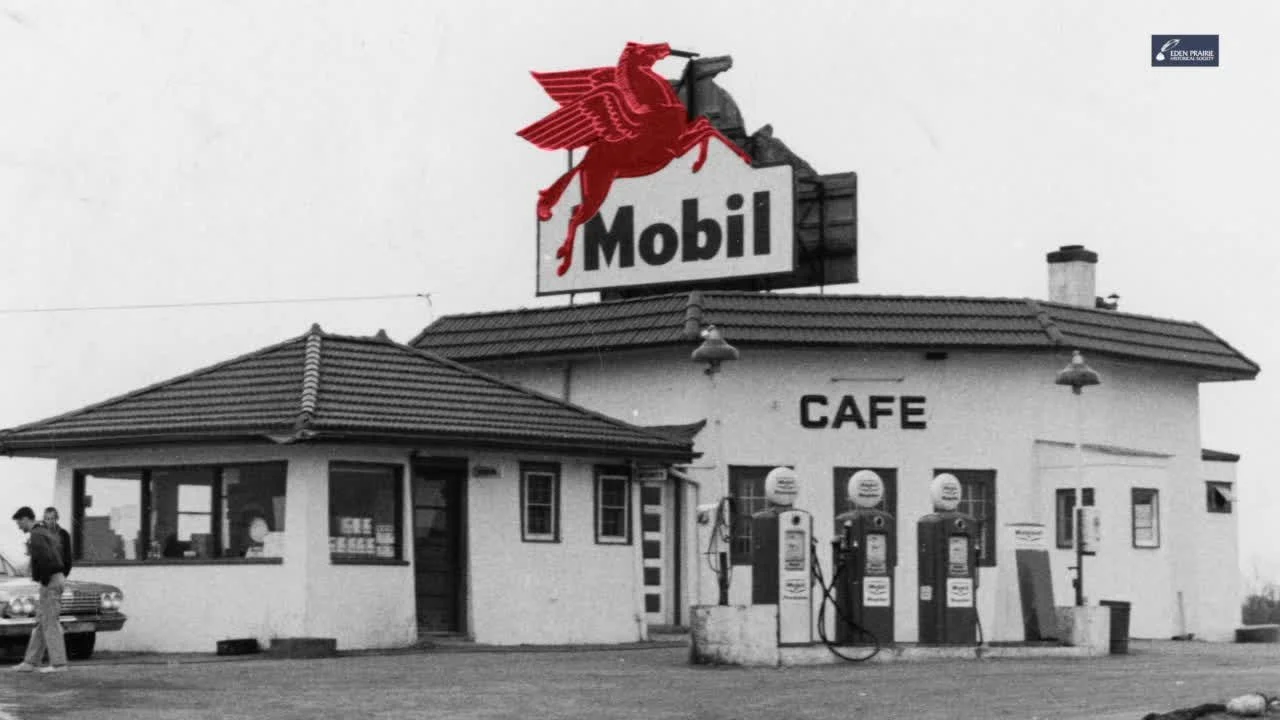
1930’s image of the Flying Red Horse sign atop the Wye Cafe and Mobil gas station in Eden Prairie, MN
Relevant Scripture
John 3:8 . . . “The wind blows wherever it pleases. You hear its sound, but you cannot tell where it comes from or where it is going. So it is with everyone born of the Spirit.”
Romans 12:2 . . . Do not conform to the pattern of this world, but be transformed by the renewing of your mind. Then you will be able to test and approve what God’s will is—his good, pleasing and perfect will.
Genesis 12:1 . . . “Go from your country, your people and your father's household to the land I will show you.”
Isaiah 40:31 . . . "Those who hope in the Lord will renew their strength. They will soar on wings like eagles."
Psalm 119:105 . . . "Your word is a lamp to my feet and a light to my path."
Ephesians 2:4-8 . . . But because of his great love for us, God, who is rich in mercy, made us alive with Christ even when we were dead in transgressions—it is by grace you have been saved. And God raised us up with Christ and seated us with him in the heavenly realms in Christ Jesus, in order that in the coming ages he might show the incomparable riches of his grace, expressed in his kindness to us in Christ Jesus. For it is by grace you have been saved, through faith—and this is not from yourselves, it is the gift of God— not by works, so that no one can boast. For we are God’s handiwork, created in Christ Jesus to do good works, which God prepared in advance for us to do.
Galatians 5:1 . . . It is for freedom that Christ has set us free. Stand firm, then, and do not let yourselves be burdened again by a yoke of slavery.
Flying Red Horse Lyrics
By John Gorka
The flying red horse from the gasoline wars
Took off from her station in the sun
Turning her back on the pack at the pump
She jumped down from the sign to run
Full serve attendants were spilling their hoses
Self-serve was doing the same
The manager dialed the emergency numbers
Insurance man won't take the claim
The sight of a horse crossing highways is frightening
But not with the breed that can fly
She's risen up to the level of oak trees
Too low for the radar man's eye
I am not much of a joiner she says
That's not where I draw my strength
Some of them go for the depth of field
While most of them go for the length
Me I will go for the hard combination
Cause I have some need to belong
But I'm leaving this unkind of sign life behind me
I'll take what is mine and be gone
If you see something red flash across the horizon
It's not that your eyes aren't right
She's taking her place with the red-tailed hawks
And the broad winged birds in flight
The flying red horse from the Ruby Red North
Took off from her station to the south
And I swear to you that this story is true
I heard it right from her mouth
They think they can tame you, name you and frame you
Aim you where you don't belong
They know where you've been but not where you're going
And that is the source of the song
John Gorka and the Holiness of the Song
Interview with Terry Roland, 2/6/13
About halfway through this interview with veteran singer-songwriter John Gorka, a clear image started to emerge. For centuries holiness has been kept behind the walls of monasteries where the monks’ primary vocation is to hold the world outside in prayer through direct communication with the divine. There’s a sense, when talking with Gorka, that he’s a kind of singer-songwriting monk on the loose out in the world. His monastery is deep within him and his relationship to his music. He covers himself in song with his warm voice, lyrics that flow out with clarity and craft, and a sensibility of the holiness of this process we call songwriting. But, there’s nothing religious about his music or his life unless religion is interpreted as a life of devotion. He calls what he experiences mystery rather than spirituality because he doesn’t know where it came from or where it is going. He only knows that it moves through him and as he surrenders to it, the birth of the song happens. He nurtures it unforced from the pressure of having to be a “hit” or make it for an audience for the purpose of a profit. Rather, the song is cared for, listened to, allowed to take its own direction. The result of this process for Gorka is a 25-year body of work that comforts, engages, and breathes with a life made from the gentle love of a song.
————————-
TR: I first heard about you when you were on Windham Hill. You also had some airplay on VH1. I remember being surprised that there was a singer-songwriter on this soft jazz-new age label.
John Gorka: I was on rotation on VH1 and the country music channel, CMT, at the time. My first record was on Red House Records. That was 1987. Then, I was signed to Windham hill in ’90 and I did five albums with them.
TR: Why did they go in the direction of singer-songwriters?
JG: Roy Ackerman began to want to get back into singer-songwriters after the success of Tracy Chapman. I liked the distribution support from the company. They had also signed Patty Larkin. There was an entire singer-songwriter wing on the label, then called High Street.
TR: How did you first get into music?
JG: I wanted to be a banjo player. I was in a bluegrass band in college called the Razzy Dazzy Spasm Band.
TR: Can you recall what made you fall in love with the banjo?
JG: It was really Flatt & Scruggs and hearing them on “The Beverly Hillbillies.”
TR: That has been a watershed moment for many banjo players.
JG: Earl Scruggs was amazing. I had the opportunity to see him and say hello when we played on the same bill at the Newport Folk Festival in 2011. That was a thrill. I stood to the side of the stage with Pete Seeger watching Earl and his band play. It was a glorious moment to be there with my two banjo heroes. The first concert I ever saw was in Asbury Park, the Earl Scruggs Review in 1973.
TR: How did you get started writing songs from learning the banjo?
JG: Six months after I learned the banjo, my brother showed me some guitar chords. That was when I found I wanted to write songs. I originally wanted to be a writer during high school.
TR: It seems many songwriters either come up through the musical path or the literary one. Who influenced you as a writer?
JG: It mostly came from the reading I’d done in high school, writers like Thomas Wolfe. I found that the parallels of words and music was fulfilling for me. Music became the best way for me to express myself in words. There were things I could express with words and music that could only be released in that way. It was the most complete form.
TR: How did you discover your songwriter’s voice?
JG: I began writing songs in high school but I became more serious in college. Music was always for fun. It was an outlet, not work in a toiling way. In college I started hanging around Godfrey Daniels (a coffee house in eastern Pennsylvania) and had the chance to open for Jack Hardy. That was June of ’79. He was the first person I’d met who wrote songs on a schedule. I knew novelists would write like that. Like a chapter a day kind of thing. But, I never considered a songwriter doing that. Jack said if you work on a schedule, instead of waiting for the song or the inspiration, you improve faster. So, I started to try that. I gave myself a deadline of one song a month. Soon I had more songs than months so I increased it to two songs a month.
TR: Did this become like a practice, like meditation or yoga?
JG: Yeah. I found I had my best ideas waking up in the morning or going to sleep at night. It seemed like the songs would begin to materialize then through a word, phrase, a chord or chord pattern. In the morning the idea would present itself to me.
TR: The meeting with Jack Hardy was really influential for you then.
JG: I gained a lot of influences and help through Godfrey’s; I was opening for people like Nanci Griffith, Mary Chapin Carpenter, and Eric Andersen. From that I was invited to be a part of the folk music scene. Jack encouraged me to enter songs in competitions. I won in at Kerrville Folk Festival in Texas for my song “Branching Out,” which eventually was on my first album.
TR: Was that when your first album started to form?
JG: Yeah, I began working on it toward the end of ’85. In the studio I made it three times before I was happy with it.
TR: It seems like in your story, even though you gained success after the first album, especially in 1990 with Windham Hill, commercial success was not your goal really. Can you speak to that?
JG: I figured I was not going to be in the mainstream. Some songs I was writing could be embraced by a large number of people, but others were not going to be mainstream. I wanted to go as far as I could with the music I was discovering. When I write I try to get the music out as I sense the song. The way it wants to come into the world. I only need to get out of the way. If I have too certain an idea of what the song is about, I’ll stunt its growth.
TR: Is there a process to this?
JG: There’s no one way to write a song. Sometimes it’s a feeling. It may be a chord or a pattern I’ve played a million times, but then it strikes an emotional response in me. I just have to be open to it. Some songs I’ll neglect. I may set it down after a while. Then, I’ll return to it in a month. By that time, it’s as if the song has its own independence. It’s not dependent on me. I return to it like someone who has never heard it.
TR: The song has a life of its own.
JG: Beck said each song was a sovereign nation with its own laws, its own life. Sometimes it’s a matter of getting the first line, then that gives me juice for the next line and the next. After a time I’ll ask, “where do we go from here?” Where do you want to go?
TR: Do you think there’s spirituality in all of this?
JG: I grew up Catholic. I don’t know if that helped or hurt! [laughs] As far as organized religion goes, I’m kind of a lost sheep. I know there’s so much more beyond what we know. I am humbled by my lack of knowledge. I’m humbled by my sense of the spiritual side; it’s so much larger than me. I think maybe for me, it’s not so much spirituality as it is mystery. I don’t know where the song has come from and I don’t know where it’s going all of the time. It’s like I’m receiving wireless messages.
TR: I enjoyed the story on your website about your meeting with Cisco Houston and Woody Guthrie.
JG: That was inspired while I was playing a Woody Guthrie night in Philadelphia. I think it was around 2009. It was inspired when I was playing the Central Valley. The promoter drove me through town and drove past a club where he said Woody had once played. The place was still there. It was the time period when Woody was doing the radio shows in Los Angles. Somehow, it seemed like it was in the realm of the possible to meet them, like that could happen.
TR: I was disappointed to find it wasn’t true! [both laugh]
JG: Woody was so great. His appeal has crossed generations and musical genres.
TR: Tell me about the Red Horse project with Lucy Kaplansky and Eliza Gilkyson.
JG: I’d done live shows with Lucy for years. Since probably 1984. We’re on Red House. It was Eliza’s idea to do some shows. It was Lucy’s husband’s idea to do a record. It was a lot of fun and a lot of work. We didn’t know how we’d sound singing together until we went to work on the record. It turned out that even though our voices were different we had a nice blend between us. So far we’ve done a lot of shows with more to come.
TR: Is anything new happening?
JG: I’ve been working on a new record. I’ve got about 14 songs recorded to listen to. I like to write more songs than I need and then record more songs than will fit onto a normal record. It’s good to listen to the songs to see how they fit together. I start with the song with strong guitar and vocal. I live with them for a while. Then, I return to them as if I was someone else to see how the life of the song is coming along. Then, I may add instruments and such.
TR: You’re still writing and recording for the album.
JG: Yeah, I like to go in to record once a week. I like to have a little pressure. Some pressure is good, but not enough to stunt the song. So, I record one day or a group of days.
TR: It sounds a lot like the way you write your songs.
JG: Yeah. Each project has its own way of coming about. It becomes what it wants to.
TR: Is there an emerging theme on this album?
JG: Yes. Mortality and a longing for spring. I want it to come out in the dead of winter, just to remind the listener of the coming spring.
TR: So there’s a sign of your Catholicism showing up. Winter Advent and waiting for Christmas?
JG: Yeah, I hadn’t thought of that. Of course, I’m careful when I record so the release may overshoot winter, which is okay. Also, I never know which songs are going to be the strongest ones when I record. Some songs take to recording better than others. That’s where I miss Bob Feldman, founder of Red House Records. He had great judgment about which songs worked the best in the studio. I’ve been fortunate to have a good label to work with.
TR: A lot of artists are going it alone without a label.
JG: There’s still a place for new artists on the smaller labels. The hardest thing is trying to get known in the digital age. There are so many people coming up who are great. When I was first on Red House, my first record didn’t sell. Going to Windham Hill helped me to develop a touring base. I had exposure. Once you’ve become known, it’s easier. And the label then takes care of resources and distribution.
TR: Thank you for your time, John. I look forward to seeing you in Southern California.
JG: Thank you. It’s been a pleasure.